Systems Engineering in the Age of Self-Improving AI: Jeff Dean at YC 2026
Reading notes on:
- Jeff Dean: The 1% Rule for Building in AI (YC Startup School 2026)
At YC Startup School 2026, Jeff Dean gave a progress report that reframes what a systems engineer does. In mid-2025 the consensus saw AI as sophisticated code-completion; by 2026 he describes models as “junior engineers” — agentic entities handling long-running, multi-day, even multi-week tasks. The shift is from reactive LLMs to proactive systems that autonomously decompose problems and iterate through the software lifecycle. But as these systems scale, their growth is governed by the hard physics of the hardware stack — so to architect 2027’s systems, you look past weights and biases to the fundamental unit of modern engineering: energy-constrained I/O.
1. The Energy-Cost Asymmetry: I/O vs. Compute
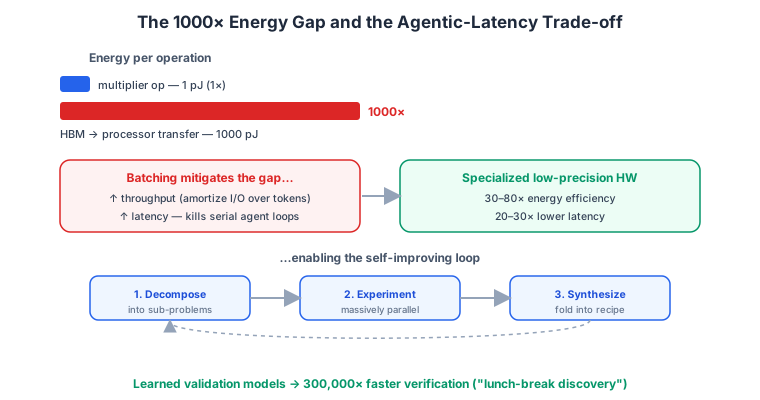
Energy, not clock speed, is now the primary performance metric — pushing the field from Von Neumann designs toward data-flow architectures. The reason is a brutal disparity:
| Operation | Energy cost | Relative factor |
|---|---|---|
| Single multiplier op | ~1 picojoule | 1× |
| Data transfer HBM → processor | ~1000 picojoules | 1000× |
That 1000× gap is what mandates batching — but batching is a systems mitigation, not an ML necessity: it amortizes the I/O penalty across many tokens at the cost of latency. For the “junior engineer” model, that trade-off bites, because agentic loops are serial chains of thought where latency is the primary blocker. Dean’s conclusion is a specialization mandate: strip general-purpose CPU overhead, focus on low-precision specialized linear-algebra units, and win 30–80× energy efficiency and 20–30× lower latency. This specialized, low-latency hardware is the substrate for autonomous loops — the same energy-aware framing behind the low-precision training work in NVFP4 training and the interconnect-scaling analysis in Collective Communication on TPU/GPU Clusters.
2. The Self-Improving ML Loop and Automated Science
We are entering “recursive improvement” — AI systems managing their own experimentation to maximize discoveries per unit of compute. This is not just automated coding; it is automating the scientific method. Dean’s 2027 vision is a three-phase cycle:
- Automated problem decomposition — break a high-level objective (“optimize this kernel’s cache footprint”) into discrete, measurable sub-problems.
- Tight experimentation cycles — massively parallel exploration of candidate solutions.
- Result synthesis — autonomously fold successes back into the master “recipe.”
Learned validation models and the 300,000× speedup. The bottleneck in scientific discovery is the validation device. In quantum chemistry, evaluating a molecular configuration via Density Functional Theory can take a full night. By training learned validation models — neural approximations of the simulator — on existing simulator outputs, engineers hit a 300,000× speedup, enabling the “lunch-break discovery” paradigm: six months of compute compressed into minutes. Replacing heavy verification with high-fidelity neural approximations lets the recursive loop iterate orders of magnitude faster — the automated-experiment discipline that also underpins Harness Engineering for Self-Improvement.
3. Context Engineering and Search-Based Inference
The model is no longer the center of the universe — it is one component in an orchestration system of retrieval, tools, and memory. A model’s weights are a “soup of trillions of tokens” stirred into a fixed parameter set; context engineering instead provides “direct clarity” — information in the prompt is prioritized and sharper than anything diffused through training data.
Dean highlighted a “performance hints” approach from a 30-page document he co-authored with Sanjay Ghemawat: by handing agents this context, they taught the agents to reason about microbenchmarks and cache footprints, then autonomously implement, measure, and iterate on low-level optimizations once reserved for senior systems engineers. Reliability across multi-agent orchestration rests on three strategies:
- Inference-time compute — spend extra compute at inference to search the solution space for the most reliable path.
- Specialized evaluator models — hierarchies where dedicated evaluator agents critique generator agents’ outputs.
- The “brightly lit path” — use skills and hints to keep agents inside their training distribution, away from high-error zones.
The failure mode as agents run for weeks is compounding error in open-loop systems; the only path to long-horizon autonomy is formal, closed-loop validation. These are the same trainer/generator and inference-scaling tensions explored in RL Systems: Mind the Gap and Reasoning Effort & Inference Scaling.
4. The 1% Rule: Strategic Moats for AI Startups
For founders, the competitive landscape is a generalist-vs-specialist tension, and the trap is the “20% trap.” The 1% rule: seek problems where general frontier models currently succeed 0–1% of the time. A 20% success rate means the problem is already inside the general model’s distribution and will be swept up by the next scaling generation; a 0–1% rate signals genuinely out-of-distribution (OOD) territory — a durable moat. Two moats endure:
- Proprietary data access — orchestrating personal or internal company data general models cannot ingest.
- Specialized niche models — high-accuracy domain models (e.g. AlphaFold for protein structure) that beat general reasoners in precision-critical fields like material science or silicon design.
In an era where agents write the code, the scarcest skill is “taste” — selecting the right problem and providing the high-level specification that steers the agents. In a spec-driven world, the person who defines the objective is the most critical asset.
5. First Principles: Reliable Systems from Unreliable Parts
The most resilient architectures come from questioning industry givens. Dean’s thought experiment: for decades we’ve assumed transistors must have near-zero error rates. What if we accepted 20 errors per day per transistor? Unreliable hardware could slash fabrication cost and energy, shifting the reliability burden to software via redundant signaling and Reed-Solomon encoding — exactly how we build reliable distributed file systems from unreliable commodity disks.
This mirrors MapReduce: by “squinting” at the problem of parallelizing Google’s index, Dean saw that a functional-programming abstraction could separate reliability logic (checkpointing, fault tolerance) from application logic, letting thousands of developers write massive parallel programs without ever thinking about machine failure.
So the 2027 engineer must retire the “bible” of 2010 latency numbers for a new checklist:
- Picojoules-per-op — the energy cost of math vs. I/O.
- Interconnect falloff — bandwidth degradation scaling from 512 to 10,000+ chips.
- Memory-to-multiplier bandwidth — the internal flow rate of the accelerator.
Takeaway. By 2027 the systems engineer’s craft is no longer manually writing logic — it is orchestrating self-improving agents: the rigorous definition of high-level specifications, and the construction of learned validation models to verify the outputs of recursive loops. The ultimate advantage becomes the ability to ask the right first-principles questions and build reliable systems from increasingly powerful yet fundamentally unreliable parts. It’s the human-in-the-loop counterpart to the model-side self-improvement in Kimi K3, which already bootstraps its own kernels and chip designs — the two halves of the same 2027 story.