Inside TPU and GPU Clusters: The Anatomy of Collective Communication
Reading notes on:
Training and serving large models in 2026 fundamentally relies on distributed systems, and sharding strategies map directly onto a small set of collective primitives:
- Data Parallelism → gradient sync via All-Reduce.
- Tensor/Model Parallelism & FSDP → All-Gather and Reduce-Scatter.
- Expert Parallelism (MoE) → All-to-All.
This complements the mental model in How to Think About GPUs for LLM Scaling and the low-latency transport work in NCCL GIN & MSCCL++.
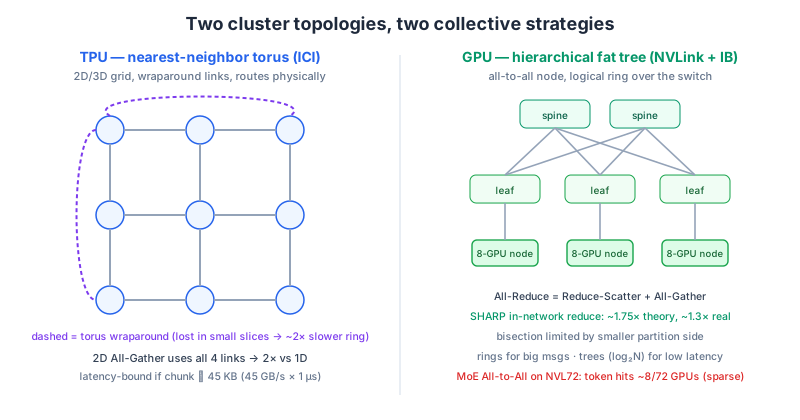
1. TPU Topology & Latency Math
TPU clusters use nearest-neighbor connectivity, forming grid topologies with periodic wraparound (torus networks).
- Dimensionality: TPU v2, v3, v5e, v6e use a 2D torus (4 neighbors); v4p, v5p, TPU7x, and 8t use a 3D torus (6 neighbors).
- Scale: the largest ICI-connected block is a TPU Pod (superpod). A v5p pod scales to 16×20×28 chips (8,960 TPUs).
- Wraparound penalty: requesting a slice smaller than a full dimension (e.g. an 8×16 slice of a 16×16 v5e pod) loses the wraparound links. Without the torus, collectives run over a 1D chain instead of a ring, roughly doubling ring-collective time along that axis.
Latency-vs-throughput crossover. Using v5e unidirectional ICI bandwidth (45 GB/s) and ~1 µs per-hop latency:
\[45\ \text{GB/s} \times 1\ \mu s = 45\ \text{KB}\]If a message chunk is ~45 KB or smaller, per-hop latency dominates. For larger payloads (~10 MB), TPUs reach near-peak collective bandwidth and standard throughput equations hold.
2. GPU Topology & Bisection-Bandwidth Math
NVIDIA clusters use hierarchical switching networks — typically a Fat Tree. Reference: the DGX H100 SuperPod (1024 GPUs).
- Scale-up domain (node): 8 H100 GPUs (or 72 in a GB200 NVL72) with all-to-all connectivity via NVSwitch/NVLink.
- Scale-out domain: nodes connect via InfiniBand; 32 nodes form a Scalable Unit (SU) via leaf switches, then spine switches.
A full fat tree matches upstream to downstream injection bandwidth (non-oversubscribed). Cross-partition bandwidth is limited by the smaller side of the partition:
- Intra-node (8 GPUs, 4 vs 4): $4 \times 450\ \text{GB/s} = 1.8\ \text{TB/s}$ unidirectional; 3.6 TB/s bidirectional.
- SU-level (32 nodes, 16 vs 16, 400 GB/s/node): $16 \times 400 = 6.4\ \text{TB/s}$ uni; 12.8 TB/s bi.
- Cluster-level (128 nodes, 64 vs 64): $64 \times 400 = 25.6\ \text{TB/s}$ uni; 51.2 TB/s bi.
- Uneven (88 vs 40): limited by the smaller side, $40 \times 400 = 16\ \text{TB/s}$ uni.
3. Collective Mechanics
For large messages, ring algorithms are the default; for small, latency-dominated payloads, tree algorithms ($\log_2$ steps) win.
- All-Gather: gathers shards so each chip holds the full matrix. On a 2D torus, a 2D All-Gather uses all 4 links for a 2× speedup over 1D.
- Reduce-Scatter: the dual of All-Gather — same schedule, but sums shards as they move. Because of this duality, if the forward pass uses All-Gather, the backward pass typically uses Reduce-Scatter (and vice versa).
- All-Reduce: composed as Reduce-Scatter followed by All-Gather.
- All-to-All: a distributed sharded transpose — the backbone of MoE dispatch/combine, where tokens grouped by source chip are routed and regrouped by destination expert.
4. GPU-Specific Optimizations
GPUs run ring algorithms by choosing a logical ring layered over the NVSwitch all-to-all fabric.
SHARP (in-network reduction). Instead of a memory-bound Reduce-Scatter + All-Gather, GPUs send partials to the switch, which reduces them (NVLink 4 NVSwitch: 400 GFLOP/s FP32) and multicasts results back.
- Theory: ~1.75× on an 8-GPU node (approaching 2× for large $N$).
- Practice: only ~30% (1.3×) — reduce/multicast pipelines don’t overlap perfectly, peak bandwidth needs multi-GB messages, and multicast wastes 1/8 of node bandwidth returning data to the source GPU.
Tree algorithms (recursive doubling/halving). Pair GPUs in rounds, cutting steps to $\log_2(N)$ instead of $N-1$. Same ideal byte cost, but less pipeline-friendly for huge tensors — they dominate only in low-latency regimes.
Hierarchical inter-node collectives. Crossing InfiniBand, algorithms pipeline across hierarchy levels. For a tensor of $D$ bytes, throughput-bound time $T \approx D / BW_\text{node} = D / 400\text{e}9$; factoring intra-node stages, $T \approx \max(D/BW_\text{gpu}, D/BW_\text{node})$.
Real-world routing nuances.
- Rail optimization: peak node bandwidth needs rail-aware rank placement so traffic stays balanced across network rails.
- Megatron TP: reducing weights sharded over a tensor-parallel axis does not All-Reduce across those ranks — it reduces element-wise across the data-parallel replicas of each TP shard.
- Sparse MoE on NVL72: dense All-to-All equations assume balanced routing. In a 72-GPU node selecting 8 experts, a token reaches only ~11% of GPUs ($8/72$) — the pattern is ragged and sparse, not a dense transpose. This is exactly the distributed-MoE regime that shapes ASIC-scale designs like LongCat-2.0 and the sequence-parallel collectives in Scaling Video Training with Sequence Parallelism.