The Mechanics of Reasoning Effort and Inference Scaling
Reading notes on:
- Controlling Reasoning Effort in LLMs (How LLMs Learn Low-, Medium-, and High-Effort Reasoning Modes)
As LLMs pivot from plain autoregressive generation to explicit “reasoning,” inference-time scaling has taken center stage. Flagship models — OpenAI’s GPT-5.6 family through open-weight models like DeepSeek-R1, Qwen3, and Inkling — now embed controllable reasoning effort. This note synthesizes the mechanisms, training recipes, and math that calibrate computational depth. It pairs naturally with the throughput view in The Economics of a Token and the training-compute view in The Architecture of Scaling Laws.
1. RLVR and the “Illusion” of <think> Tokens
State-of-the-art reasoning is trained mostly via Reinforcement Learning with Verifiable Rewards (RLVR) — domains where correctness is computationally checkable (math via symbolic solvers, code via compilers/tests). A key insight: the intermediate reasoning trace itself is not scored for accuracy — only the final answer is. Self-corrections mid-trace are the famed “Aha” moments.
The <think>/</think> tags don’t grant reasoning ability; they’re cosmetic delimiters, incentivized by a formatting reward added to the RLVR objective:
2. The On/Off Switch: Thinking Mode Fusion
Early reasoning models couldn’t turn off their verbose traces. Hybrid architectures like Qwen3 add a post-training SFT phase — Thinking Mode Fusion — pairing prompts with two target formats:
/think:<think>{reasoning}</think>{answer}/no_think:<think></think>{answer}
At inference, a hard switch at the tokenizer level (enable_thinking=False) injects an empty <think></think> block into the assistant prefill, forcing the model to skip reasoning and answer immediately.
3. Calibrating Depth: The Math of Reasoning Budgets
Beyond binary switches, models like GPT-5.6 and Inkling let you dial effort (Low/Medium/High, or a continuous scalar) — inference-time compute scaling via the token budget. The most sophisticated approach modifies the RLVR objective with a dynamic length penalty conditioned on a requested effort $e \in [0.0, 1.0]$ passed in the system prompt:
\[R(e) = R_{\text{task}} - \lambda(e)\, N_{\text{tokens}}\]- $R_{\text{task}}$: baseline accuracy reward.
- $N_{\text{tokens}}$: reasoning-trace length.
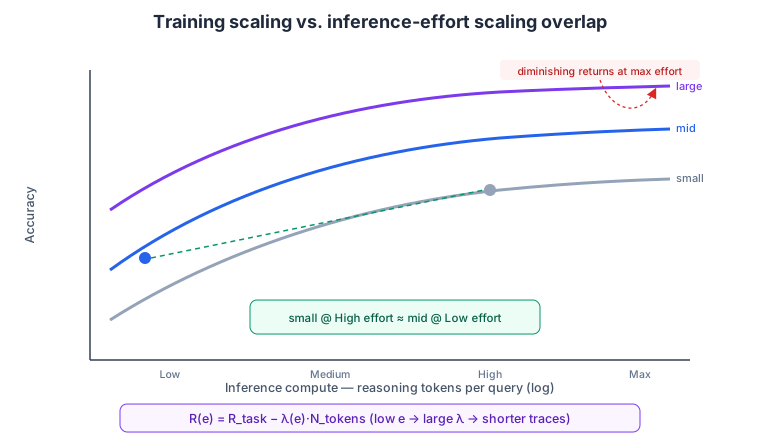
- $\lambda(e)$: penalty coefficient mapped from $e$. Low $e$ → large $\lambda$ (heavy per-token cost → short, efficient traces); high $e$ → small $\lambda$ (large budget to explore deeper reasoning trees).
4. Recipes in SOTA Open-Weight Models
- DeepSeek-V4 (distilled specialists): on-policy distillation from a pool of specialized teachers; “Non-think”, “Think High”, “Think Max” modes, each with tuned context and length penalty. “Think Max” is triggered by a strict system prompt. (See DeepSeek-V4 Architecture & Training.)
- Nemotron 3 Ultra (truncation robustness): during SFT, traces are randomly truncated at token limits,
</think>is masked from the loss, and the original final answer is appended — teaching graceful close-out under hard budgets. (See Deep Dive into Nemotron 3 Ultra.) - Kimi K2.5 (the toggle method): alternate two RL phases; in the “budgeted phase,” correct solutions must fit a strict token budget (dynamic percentiles of successful rollouts), enforced only after the model crosses an accuracy threshold — preventing premature reasoning collapse.
- GLM-5 (granular turn-level thinking): multi-turn controls via SFT — “interleaved thinking” (reasoning before tool calls) and “preserved thinking” (keeping earlier reasoning in history). (See GLM-5.2.)
5. The Training vs. Inference Scaling Frontier
A profound observation: model scaling (training compute) and effort scaling (inference compute) overlap. A smaller model (e.g. GPT-5.6 Luna) at High effort can match a larger model (Terra) at Low effort. But the highest limits hit diminishing returns — GPT-5.6 Sol at max effort spends enormous token counts for sub-proportional accuracy gains, the same efficiency ceiling explored in Efficiency in LLMs.
Implication: today’s paradigm relies on user-dictated system prompts to set effort. Going forward, the optimal accuracy-per-dollar intersection will be routed dynamically — agentic wrappers computing the best model-size / token-penalty ($\lambda(e)$) tradeoff from task complexity, failure cost, and token limits.