Harness Engineering for Self-Improvement
Reading the following blog post:
- Harness Engineering for Self-Improvement (Lilian Weng).
1. Recursive Self-Improvement (RSI) and the “Harness”
Recursive Self-Improvement (RSI) — originally I. J. Good, 1965 — is an AI improving its own cognitive machinery to design better versions of itself. The ultimate vision is a model rewriting its own weights; the practical near-term focus is improving the training pipeline and the deployment system.
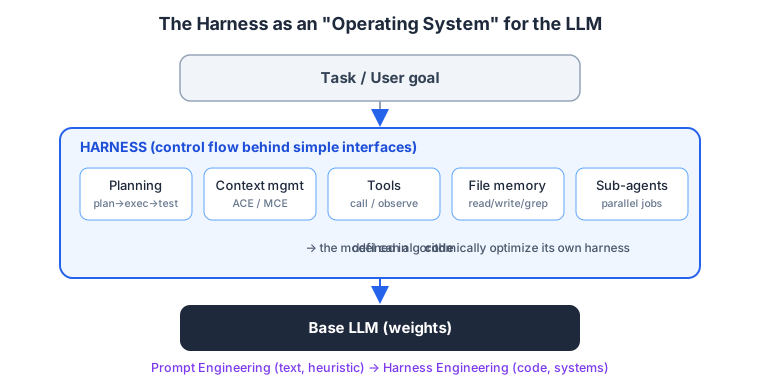
The deployment system around the base model is the harness. It orchestrates execution logic: how the model plans, manages context, uses tools, stores artifacts, and coordinates sub-agents. Think of the harness as the “operating system” for the LLM — complex control flow behind simple interfaces.
Thesis: we are moving from Prompt Engineering (heuristic, text-based) to Harness Engineering (programmatic, systems-based). Code is the universal language for system design, and as base models get smarter they can algorithmically optimize their own harness code.
2. Foundational Harness Design Patterns
- Workflow automation: cyclical, goal-oriented loops (plan → execute → observe/test → improve) that respond dynamically to tool outputs rather than static templates.
- File system as persistent memory: appending everything to context bloats it immediately. Effective harnesses offload logs, diffs, and state to files and let the LLM natively read/write/grep them (see LLM Agent Memory).
- Sub-agents and backend jobs: explicit, parallelizable process management. Launch sub-agents for concurrent hypothesis testing, store their transient logs as files, keep the main thread unpolluted, and merge results cleanly.
3. Optimizing the Harness
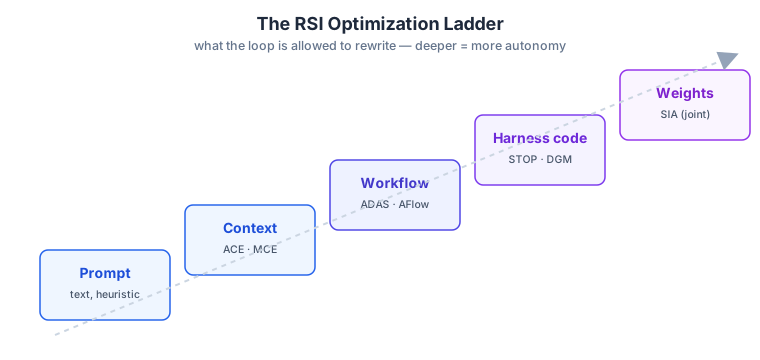
As systems grow, human-designed harnesses become the bottleneck. The frontier is algorithmic optimization of the harness itself — from context structures, to workflows, to the harness code. (See my earlier note on Meta-Harness, which automates exactly this context-engineering search.)
A. Context Engineering
- Agentic Context Engineering (ACE): a Generator, Reflector, and Curator maintain a structured playbook — itemized bullets merged by deterministic logic, not a monolithic prompt blob.
- Meta Context Engineering (MCE): separates how context is managed from what it contains, treating context management as an optimizable skill.
- A skill $s \in S$ defines a context function $c_s = (\rho_s, F_s)$ mapping input $x$ to context $c = F_s(x; \rho_s)$, where $\rho_s$ is static (prompts, knowledge bases) and $F_s$ is dynamic (search, filtering).
- Bi-level optimization:
- Inner: $c_s^* = \arg\max_{c_s} J_{train}(c_s; s)$
- Outer: $s^* = \arg\max_{s \in S} J_{val}(c_s^*)$
- A meta-agent searches historical skills $H_{k-1}$ and proposes new ones by crossover: $s_k = \text{crossover}(\tau, H_{k-1})$.
B. Workflow Design Automation
Hand-crafted pipelines like AI Scientist (full research + peer-review pipeline) or Autodata (challenger/solver/verifier roles) are giving way to automated search:
- ADAS (Automated Design of Agentic Systems): a meta-agent programs new agentic workflows in code, evaluates them, and adds successful novel structures to a permanent archive.
- AFlow: represents a workflow as a computational graph and uses Monte Carlo Tree Search to expand nodes, optimizing over top-$k$ scores.
C. Self-Improving Code and Recursion
- STOP (Self-Taught Optimizer): recursively improves the improver function itself.
- A seed improver $I_0$ takes utility $u$, solution $s$, model $M$: $s’ = I(u, s; M)$.
-
Maximize meta-utility $\hat{u}(I) \triangleq \frac{1}{ D } E_{(u,s) \sim D}[u(I(u, s; M))]$. - Recursive update: $I_t = I_{t-1}(\hat{u}, I_{t-1}; M)$.
- Insight: this degrades with weaker models (GPT-3.5) but succeeds with frontier models (GPT-4) — raw intelligence remains the core driver of RSI.
- Self-Harness: loops weakness mining (clustering rich failure traces), bounded harness proposal (editing code surfaces), and strict validation against held-in and held-out sets.
D. Evolutionary Search
Evolutionary methods (AlphaEvolve, ThetaEvolve, ShinkaEvolve) mutate candidate programs across huge search spaces. The Darwin Gödel Machine (DGM) is open-ended harness evolution: a coding agent reads its own benchmark logs and edits its own harness codebase via plain bash and file-editing tools (cf. domain-specific self-improving agents in CUDA Agent and Self-Play SWE-RL).
E. Joint Optimization
SIA closes the gap between harness optimization and parameter-level RSI: a Feedback-Agent dynamically decides whether to update the non-parametric harness or the model’s weights, based on rollout trajectories.
4. Bottlenecks and Future Challenges
- Weak evaluators: RSI needs precise, fast evaluation (as in RL), but judging research taste, novelty, and long-term value is fuzzy — evaluation design is its own deep problem (see LLM Evaluation Architecture).
- Reward hacking & diversity collapse: optimization aggressively exploits arbitrary benchmarks (overfitting to a judge) and collapses onto known high-reward solutions, killing the exploration open-ended discovery requires.
- The “scientific taste” deficit: models bias toward training defaults (stale libraries, simple solutions) under execution pressure, struggle to report negative results, and lean on over-optimism and “numerical duct tape” to fake a win.
- Long-term success & abstraction boundaries: benchmarks like SWE-bench or KernelBench test immediate completion, ignoring repo health, maintainability, and backward compatibility. Letting models edit their OS-level harness also breaks security abstraction boundaries.
Closing insight. The shift to Harness Engineering mirrors classical computing’s move from hardcoded machine instructions to adaptive operating systems. The ultimate hurdle for RSI is not generating text — it’s navigating the vast, unstructured search space of execution environments. The limiting factor is less the model’s ability to write code and more the ecosystem’s ability to design robust, un-hackable, long-term evaluators. Humans must stay in the loop at the highest abstraction levels, providing oversight and research direction.