ParallelKittens: Three Principles and Eight Primitives for Multi-GPU Kernels
Reading notes on:
Inside a single GPU, the memory wall is mostly under control. IO-aware algorithms like FlashAttention and tile DSLs like ThunderKittens made HBM traffic something you design around. Between GPUs, the wall is getting taller. Inter-GPU communication over NVLink/NVSwitch now accounts for over 50% of execution time in LLM training and inference, because the hardware generations have scaled unevenly:
| Resource (A100 → B200) | Scaling |
|---|---|
| BF16 Tensor Core compute | 7.2× |
| HBM bandwidth | 5.1× |
| NVLink bandwidth | 3× |
| PCIe / InfiniBand bandwidth | 2× |
For reference, NVLink is 450 GB/s unidirectional per GPU on H100 and 900 GB/s on B200. Each generation, compute per byte of interconnect gets larger, so more of a kernel’s wall-clock time goes to communication unless it is hidden behind compute. The existing ways of hiding it each have a flaw:
- Bespoke operators (FLUX, Comet, FlashDMoE) hand-tune one operation in low-level CUDA, CUTLASS, or NVSHMEM. They are fast, but they can’t be reused and they break when the architecture changes.
- Compiler frameworks (Triton Distributed) don’t adapt to new accelerators. Triton Distributed was developed on H800s and sometimes runs below the non-overlapped baseline on H100s.
- Communication libraries (NCCL, NVSHMEM) add synchronization handshakes and intermediate buffering that a fused kernel does not need.
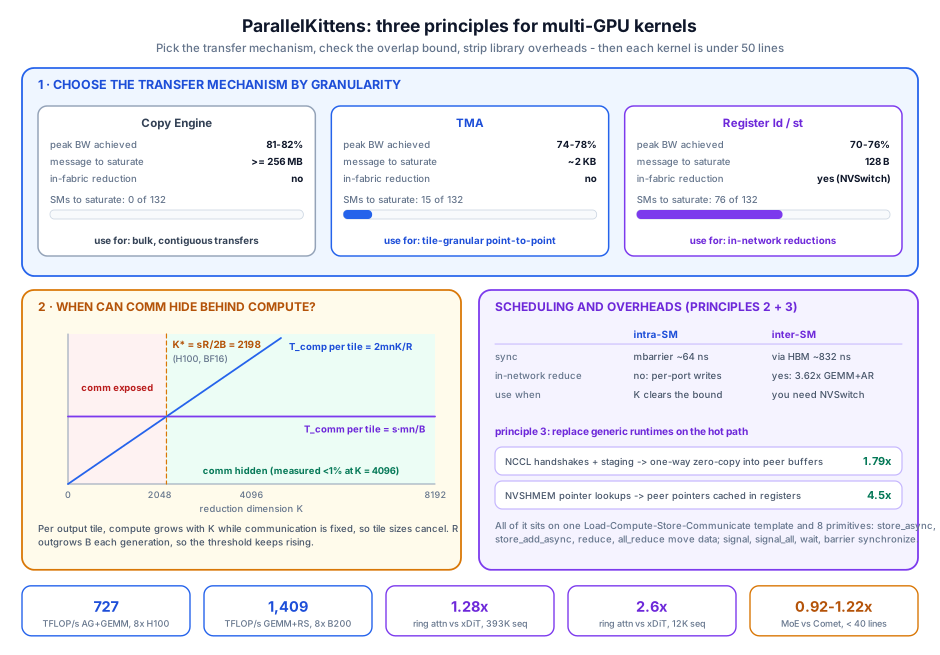
ParallelKittens (PK) turns multi-GPU kernel design into three principles, then encodes them in a small set of C++ primitives on top of ThunderKittens. Kernels written this way take under 50 lines of device code and land within about 10% of hand-tuned state of the art, often ahead of it, across data, tensor, sequence, and expert parallelism. It is the human-written counterpart to the agent- and compiler-driven kernel work in Cake, and a general-purpose relative of the NVL72 MoE megakernel in Mixture-of-Kittens. It also appeared briefly in my MLSys 2026 poster notes.
1. A Cost Model for Multi-GPU Kernels
PK models a kernel’s wall-clock time as
\[T_{\text{kernel}} = T_{\text{launch}} + \max(T_{\text{comp}}, T_{\text{mem}}, T_{\text{comm}}) + T_{\text{non-overlap}} + T_{\text{sync}}\]- $T_{\text{launch}}$: per-kernel launch cost, meaning host-side latency plus per-thread-block setup and teardown (tensor memory allocation, pipeline fill and drain).
- $T_{\text{comp}}, T_{\text{mem}}, T_{\text{comm}}$: the Tensor Core, local HBM, and interconnect pipelines, with $T_{\text{comm}} = S_{\text{comm}} / B_{\text{comm}}$.
- $T_{\text{non-overlap}}$: communication that could not be hidden behind compute.
- $T_{\text{sync}}$: inter-SM or inter-device synchronization latency.
A perfect kernel is a single $\max$. The design goals follow directly: drive $T_{\text{non-overlap}} \to 0$, shrink $T_{\text{sync}}$, and saturate $B_{\text{comm}}$. Each of the three principles targets one of those terms.
2. Principle 1: Choose the Transfer Mechanism by Granularity
Datacenter GPUs can move data over NVLink in three ways, and they behave very differently:
| Mechanism | Peak BW achieved | Message size to saturate | SMs to saturate | In-fabric reduction |
|---|---|---|---|---|
| Copy Engine (CE) | 81–82% | $\ge$ 256 MB | 0 (host-driven) | No |
| TMA | 74–78% | ~2 KB | ~15 | No |
Register ops (ld/st) |
70–76% | 128 B | ~76 | Yes (NVSwitch) |
Three takeaways:
- Copy engines win on bulk transfers and lose on tiles. They reach the highest aggregate throughput (368.82 GB/s on H100, 726.13 GB/s on B200), but only with contiguous payloads of $\ge 256$ MB. For tile-granular traffic such as MoE token routing, CE efficiency collapses. Device-initiated methods reach comparable utilization at 2 KB messages. This is why Triton Distributed, Flux, and CUTLASS, which all use the copy engine for intra-node all-gather GEMM, fall behind the non-overlapped baseline at small matrix sizes.
- SM cost differs by 3.2–5.1×. Register instructions are synchronous and consume registers, so it takes ~76 SMs issuing concurrently to saturate the link. TMA is asynchronous and issued by a single thread, so ~15 SMs are enough. Every SM spent on communication is taken away from the GEMM.
- Only register ops can reduce in the fabric.
multimem.ld_reduceandmultimem.redare the only way to use NVSwitch’s hardware-accelerated in-network reduction.
So the choice is not about peak bandwidth, which is within ~10% across all three. It is about message size, SM budget, and whether you need a reduction. Taking the CPU off the critical path is the same idea behind NCCL GIN and MSCCL++. PK applies it inside a fused compute kernel.
3. Principle 2: Schedule the Overlap, and Know When It Is Possible
When can communication hide behind compute?
Take a fused $M \times N \times K$ GEMM + reduce-scatter on $P$ GPUs, processing $m \times n \times k$ tiles. One $m \times n$ output tile needs $K/k$ sub-GEMMs, so at sustained Tensor Core throughput $R$:
\[T_{\text{comp,tile}} = \frac{2mnk}{R} \cdot \frac{K}{k} = \frac{2mnK}{R}\]Sending that tile (element size $s$ bytes) over NVLink bandwidth $B$:
\[T_{\text{comm,tile}} = \frac{s \cdot mn}{B}\]Overlap is possible when compute per tile exceeds communication per tile:
\[\frac{2mnK}{R} \ge \frac{s \cdot mn}{B} \;\implies\; K \ge \frac{s \cdot R}{2B}\]The tile dimensions cancel, so only the reduction dimension $K$ matters. For H100 in BF16 ($s = 2$, $R = 989$ TFLOP/s, $B = 450$ GB/s):
\[K \ge \frac{2 \times 989 \times 10^{12}}{2 \times 450 \times 10^{9}} \approx 2198\]The paper checks this with a fused GEMM + RS against a standalone GEMM ($M = N = 32768$):
| $K$ | GEMM (ms) | GEMM + RS (ms) | Non-overlapped comm |
|---|---|---|---|
| 512 | 2.071 | 6.483 | 68% |
| 1024 | 2.918 | 6.613 | 56% |
| 2048 | 5.567 | 7.531 | 26% |
| 4096 | 11.780 | 11.828 | < 1% |
| 8192 | 23.285 | 25.325 | 8% |
At $K = 2048$, just under the bound, the exposed fraction roughly halves. The authors attribute the remainder to the atomic additions used for output-tile accumulation. At $K = 4096$ communication is essentially fully hidden. The 8% at $K = 8192$ is in the paper’s table but isn’t discussed in the text. The bound also explains the scaling table above: $R$ grows faster than $B$ each generation, so the threshold $K$ rises, and shapes that overlapped cleanly on the previous GPU stop overlapping on the next one. It is the same roofline reasoning as designing GEMM shapes for the GPU, extended with an interconnect ceiling.
Intra-SM vs. inter-SM overlap
- Intra-SM: within one SM, one thread group drives the MMAs while another issues async TMA. Synchronization uses a hardware
mbarrierat ~64 ns. - Inter-SM: partition the SMs into a compute group running the local GEMM and a communication group. Synchronization goes through HBM at ~832 ns, 13× slower.
Intra-SM overlap keeps every SM’s Tensor Cores busy and syncs cheaply, so it is the default when $K$ clears the bound. Inter-SM overlap is needed when you want in-network reduction. With intra-SM overlap, peer writes serialize over per-port NVLink links. Dedicated communication SMs can instead accumulate partials in HBM and hand one all-reduce to NVSwitch, which cuts $T_{\text{comm}}$ by roughly a factor of the GPU count. The measurements (8× H100, $N = 32768$) show both sides of the trade-off:
| Kernel | No overlap | Intra-SM | Inter-SM |
|---|---|---|---|
| GEMM + RS | 510.1 | 743.7 | 618.1 |
| GEMM + AR | 450.9 | 172.3 | 623.9 |
Intra-SM wins for reduce-scatter. For all-reduce, intra-SM is worse than no overlap, and inter-SM is 3.62× faster than intra-SM.
4. Principle 3: Remove Software Overheads
General-purpose communication libraries pay for generality with latency, and a fused kernel doesn’t need that generality:
- NCCL handshakes and staging. NCCL requires two-way sender/receiver synchronization and routes payloads through pre-allocated intermediate channels. PK pre-allocates destination buffers on the peer and does one-way, asynchronous, zero-copy writes directly into them. On an all-reduce kernel this gives up to 1.79× over NCCL on B200 (1.32× on H100), both at the smallest size tested. The gain shrinks to about 1.04× at the largest size, where NCCL’s overheads are amortized.
- NVSHMEM address resolution. The public NVSHMEM API does a global load (
ldg) on every peer access to resolve the remote virtual pointer, and forces CTA-wide__syncthreads. PK keeps pre-resolved peer pointers in registers, cutting element-wise NVLink access latency by up to 4.5× and raising bandwidth utilization by about 20 GB/s.
5. The Abstractions
Memory hierarchy, extended across GPUs
| Abstraction | Where it lives | Capacity / bandwidth (H100) |
|---|---|---|
Register tile rt<M, N> |
registers | 64K 32-bit registers per SM (the paper writes “64 KB”) |
Shared tile st<M, N> |
SMEM | 227 KB/SM, ~33 TB/s |
| (L2 cache) | on-chip, shared by all SMs | 50 MB, ~12 TB/s |
Global layout gl |
HBM | 80 GB, ~3 TB/s |
Parallel global layout pgl |
identically allocated tiles on every GPU | NVLink |
The pgl is the new piece: memory regions of identical shape and size allocated on every GPU, so a tile coordinate refers to the same logical tile on every peer. P2P transfers, broadcasts, in-fabric multicast and reductions then become ordinary tile operations.
The LCSC template
Kernels follow a Load-Compute-Store-Communicate template with four worker roles:
- Compute SMs: a loader (TMA reads from local or peer HBM), a consumer (Tensor Core or CUDA-core compute), and a storer (writes to local or peer HBM). When the loader or storer touches peer HBM, that is intra-SM overlap.
- Communication SMs: a communicator that occupies one or more SMs exclusively for dedicated communication. That is inter-SM overlap.
The user writes the four functions. The template handles kernel configuration, shared memory and TMA setup, semaphores and barriers, and the split of SMs between compute and communication (num_comm_sms), which it auto-tunes.
Eight primitives
| Primitive | What it does |
|---|---|
store_async(dst, src, idx) |
Async TMA store from an st tile to multicast pgl memory |
store_add_async(dst, src, idx) |
Async atomic-add reduction from st to pgl |
reduce<TILE_ROWS, TILE_COLS, OP>(dst, dst_idx, src, src_idx) |
In-network reducing load (sum, max, or min) from pgl into local gl |
all_reduce<TILE_ROWS, TILE_COLS, OP>(dst_and_src, idx) |
In-place in-network all-reduce over multicast memory |
signal(bar, idx, dev_idx, val) |
Atomically add val to a specific device’s barrier counter |
signal_all(bar, idx, val) |
Multicast atomic add to every device’s barrier counter in one operation |
wait(bar, idx, dev_idx, expected) |
Spin-wait with relaxed ordering until the barrier reaches expected |
barrier(bar, idx, dev_idx) |
Global multi-device barrier |
Four primitives move data and four synchronize. All of them work on tiles, from 16×16 up to the shared-memory limit (about 256×256), addressed by int4 coordinates. The P2P stores are asynchronous and issued by a single thread, so they fuse with compute. The network-accelerated reductions need at least a warp for full throughput. That small surface is how a fused MoE dispatch + grouped GEMM fits in under 40 lines of device code.
6. Under the Hood: CUDA VMM and Multicast Handles
Plain CUDA IPC (cudaIpcGetMemHandle / cudaIpcOpenMemHandle) works on existing tensors but cannot use NVSwitch acceleration. PK therefore uses the virtual memory management (VMM) API:
- Allocate physical memory with
cuMemCreate, settingCU_MEM_HANDLE_TYPE_POSIX_FILE_DESCRIPTOR, then reserve and map a local virtual address withcuMemAddressReserve+cuMemMap. - Export the physical allocation as a Linux file descriptor with
cuMemExportToShareableHandle. File descriptors are process-local, so the FD is sent as a control message over a Unix domain socket. - The receiving process imports it with
cuMemImportFromShareableHandle, then reserves and maps its own virtual address. - For in-network acceleration, create a multicast object with
cuMulticastCreate, register devices withcuMulticastAddDevice, and bind each device’s physical memory withcuMulticastBindMem. The multicast object is itself exported as a POSIX FD and mapped into every process the same way.
Each process ends up with two addresses: a local one for ordinary loads and stores, and a multicast one. A write to the multicast address is broadcast by the NVSwitch fabric, and PTX multimem.red / multimem.ld_reduce on it perform in-fabric reductions. A plain read from the multicast address is undefined behavior.
VMM allocations carry a 2 MB granularity requirement on H100 and B200, so ordinary cudaMalloc-backed PyTorch tensors can’t be shared directly. PK needs a custom tensor class with its own VMM allocation. This one-time setup is also what makes the pre-resolved register pointers from Principle 3 possible.
7. Results
Benchmarks run on 8× H100 SXM5 80GB and 8× B200, connected by NVLink/NVSwitch.
| Parallelism | Baseline | PK relative performance | Residual non-overlapped comm |
|---|---|---|---|
| Data / tensor | cuBLAS + NCCL | 1.06–1.68× | < 1% at large $K$ |
| Triton Distributed | 1.07–5.63× | ||
| Flux | 0.97–2.33× | ||
| CUTLASS | 0.90–7.39× | ||
| Sequence (Ring Attention) | xDiT (NCCL P2P + FlashAttention-3) | 1.07–4.08× (paper text) | ~9% |
| Sequence (Ulysses) | YunChang | 1.01–1.39× | |
| Expert (MoE) | Comet | 0.92–1.22× | ~15% |
Ranges below 1× mean a hand-tuned baseline wins at some sizes. The headline “up to 2.33×” for tensor parallelism is the maximum over Flux across all sizes, not a typical speedup.
Tensor parallelism ($N = 32768$, 8× H100)
- AG + GEMM: PK 727 TFLOP/s vs. Flux 662, CUTLASS 628, Triton Distributed 528, cuBLAS + NCCL 493. At $N = 16384$, Flux leads (699 vs. 675).
- GEMM + RS: PK 744 TFLOP/s vs. Triton Distributed 602, cuBLAS + NCCL 510, Flux 431, but CUTLASS is faster at 793. CUTLASS also leads at $N = 16384$ (640 vs. 575).
- GEMM + AR (no Flux or CUTLASS kernel exists): PK 624 vs. cuBLAS + NCCL 451 and Triton Distributed 317.
- B200 GEMM + RS: PK 1,409 TFLOP/s vs. cuBLAS + NCCL 960 (1.47×).
So PK is not uniformly fastest. It gets ~1.47× over the non-fused cuBLAS + NCCL pipeline on both generations, beats Flux by 10% on AG + GEMM, and trails CUTLASS by 6% on GEMM + RS. The authors point out that AG + GEMM and GEMM + RS usually run back-to-back, and no single baseline beats PK on the pair. The real claim is consistent near-best performance from a few dozen lines of code, rather than a dedicated kernel project per operator.
Sequence parallelism
- Ring Attention: blockwise attention fused with async KV tile transfers, using inter-SM overlap, reaches 623 TFLOP/s at sequence length 393,216, 1.28× over xDiT’s 488. The gap is largest at the shortest sequence, 12,288: 434 vs. 167, or 2.6×. There, xDiT’s coarse stream-level overlap has too little compute per KV block to hide the transfer. The paper’s text states 1.07–4.08×, but no point in its Ring Attention figure (Figure 10) exceeds 2.6×. The 4.08× must come from a configuration that isn’t plotted.
- DeepSpeed-Ulysses: a fine-grained multi-dimensional all-to-all removes the tensor-reshape overheads, reaching 661 TFLOP/s on H100 (vs. YunChang’s 652) and 1,336 TFLOP/s on B200 (vs. 1,297) at sequence length 393,216. The larger gains (up to 1.39×) come at shorter sequences.
Both are the sequence-parallel schemes behind long-context video training. Here the communication is fused into the attention kernel instead of wrapped around it.
Expert parallelism
The benchmark covers the first half of an MoE layer, token dispatch overlapped with the first expert MLP, at a DeepSeek-V3-like shape (top-8 of 256 experts, $H = 7168$, expert hidden size 2048). PK adds fewer than 40 lines of device code to a grouped GEMM kernel:
| Total tokens | 8,192 | 16,384 | 32,768 | 65,536 | 131,072 |
|---|---|---|---|---|---|
| cuBLAS + NCCL | 66 | 136 | 149 | 147 | 150 |
| Comet | 245 | 329 | 425 | 424 | 462 |
| PK | 298 | 374 | 411 | 413 | 426 |
PK leads at small token counts (1.22× at 8K) and trails Comet by 3–8% from 32K tokens up. The paper summarizes this as “matches or surpasses”, which is generous: at the largest size, 426 vs. 462 is a 0.92× loss. MoE is also where the residual non-overlapped communication is highest (~15%): data-dependent routing makes the traffic irregular and harder to schedule. That is why dedicated work like Mixture-of-Kittens and UltraEP keeps going after the MoE layer specifically.
Takeaways
- Don’t use copy engines for fine-grained overlap. They need >256 MB transfers to saturate NVLink. Use async TMA for tile-granular point-to-point traffic, with ~15 SMs and 2 KB messages.
- Check the overlap bound before writing the kernel. If $K \ge sR/2B$ (≈2.2K for BF16 on H100; fully hidden by $K = 4096$ in practice), use intra-SM overlap and keep every Tensor Core busy. If you need in-network reduction, switch to inter-SM overlap and let NVSwitch do the reduction (3.62× on GEMM + AR). The bound rises every generation because $R$ outgrows $B$.
- Bypass generic runtimes on the hot path. Pre-allocated VMM handles and one-way zero-copy writes replace NCCL’s handshakes (1.79×). Register-cached peer pointers replace NVSHMEM lookups (4.5×).
- A small set of primitives gets close to hand-tuned. Eight primitives and one LCSC template cover TP, Ring and Ulysses SP, and EP within about 10% of the best hand-tuned kernel everywhere, and ahead of it in many cases. CUTLASS still wins GEMM + RS at large sizes, and Comet wins large-batch MoE dispatch.