Mixture-of-Kittens: A MoE Megakernel for GB300 NVL72
Reading notes on:
As expert counts and expert-parallel (EP) degrees scale, the MoE layer has flipped from a structural advantage into the primary execution bottleneck — often over 50% of end-to-end training time, dominated by high-frequency all-to-all token routing that serializes into interconnect contention and execution bubbles. Mixture-of-Kittens (MoK) is a MoE megakernel co-designed for the single NVLink domain of GB300 NVL72, in the same “fuse the whole layer” spirit as the epilogue-programming work in CODA and the communication-library lessons from NCCL GIN & MSCCL++.
1. The NVL72 Bottleneck
The GB300 NVL72 abandons discrete fat-tree topologies for a single-hop, non-blocking NVLink fabric: the 72-GPU rack is one unified NVLink domain — effectively a distributed shared-memory clique with 1.8 TB/s per-GPU bidirectional bandwidth. That enables fine-grained compute/comm overlap and specialized kernels, but it exposes two asymmetries:
- Grace–GPU imbalance. Blackwell GPUs finish streams faster than the integrated Grace CPUs can launch kernels and manage runtime metrics. This “GPU starvation,” compounded by high-latency CPU–GPU sync, means anything on the host critical path stalls the accelerators. The mandate: move routing, scheduling, and buffer management entirely on-device.
- Communication contention. Standard general-purpose primitives leave NVLink lanes underutilized during imbalanced routing.
The rest of MoK is a set of co-designs that keep the GPUs at 100% duty cycle by taking the CPU off the critical path.
2. Push vs. Pull: Communication Direction Co-Design
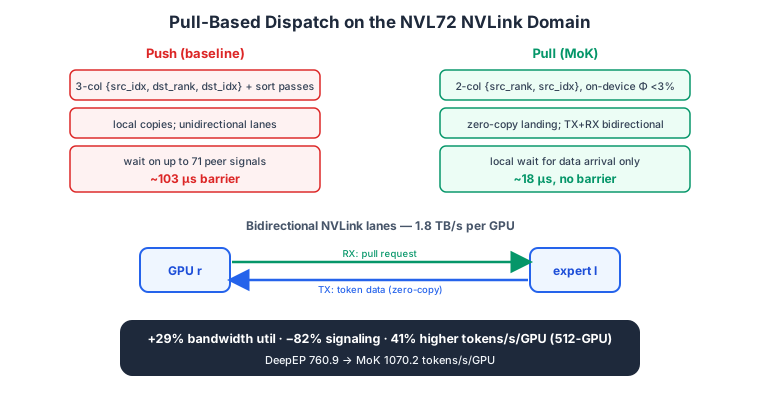
The first lever is direction. Push-based dispatch is standard for scattering, but pull-based dispatch fits MoE’s zero-copy layouts and expert imbalance far better:
| Feature | Push-based | Pull-based |
|---|---|---|
| Schedule metadata | 3-column ${src_{idx}, dst_{rank}, dst_{idx}}$ | 2-column ${src_{rank}, src_{idx}}$ |
| Complexity | high (multi-pass sort/coord) | low (direct buffer alignment) |
| Local memory ops | local copies often required | zero-copy (direct landing) |
| Lane symmetry | unidirectional-dominant | high bidirectional (TX/RX) |
Push requires a 3-column table plus multiple sorting passes to keep source ranks from colliding on a destination address. Pull aligns a 2-column table directly with destination buffers, landing tokens zero-copy in contiguous memory with no cross-rank coordination.
| On-device schedule generation. MoK builds the schedule table $\Phi$ entirely on-device at <3% runtime overhead, in two passes over the routing tensor $E$: first count per-expert, per-rank tokens ($T$, $M$) and prefix-sum into offsets $S$; then place each token at $\Phi[S[l] + p]$ using a stable cross-rank position $p = \sum_{r’<R}\min(M[l,r’],o) + | {r’<r : M[l,r’]>o} | $. |
The payoff is in the signaling. Pull requests exploit both TX and RX lanes concurrently, delivering up to 29% higher bandwidth utilization despite higher metadata bytes. And pull signaling is local: instead of waiting on up to 71 peer signals (~103 μs) as push does, the rank issuing the load waits only for its data to arrive (~18 μs) — no global barrier. Net: 82% less signaling overhead. MoK uses an asymmetric scheme to reuse $\Phi$ across passes — forward = pull-dispatch / push-combine, backward = pull-reverse-combine / push-reverse-dispatch.
3. The Goldilocks Minibatch Size $T$
The token count per transfer $T$ governs compute/comm overlap: too small and tensor cores starve, too large and the sparse-wave “tail effect” wastes work. Deriving from first principles on Blackwell — where one wave occupies all SMs at a $128\times256$ output tile, and hiding GEMM epilogue latency needs at least two waves ($2C$):
- Up/Gate projections (parallel), output tiles $\frac{128\,T\,256}{2I} \ge 2C$;
- Down projection (sequential), bottlenecked by hidden dim $H$: $\frac{128\,T\,256}{H} \ge 2C$.
Unified: $T \ge \dfrac{2C \cdot 128 \cdot 256}{\min(2I, H)}$.
Kimi 2.5 case study ($H=7168$, $I=2048$, Blackwell $C=148$): $\min(2\cdot2048, 7168) = 4096$, so $T \ge \frac{2\cdot148\cdot128\cdot256}{4096} = 2368$. Empirically latency stabilizes at $T \approx 2560$ (5.981 ms at 512 → 3.425 ms at 2560, flat past there), matching the bound.
4. Ring Token Buffers: No CPU-GPU Sync
MoE routing produces unknown per-rank token counts, which normally forces token dropping or costly CPU-GPU sync for buffer allocation. MoK’s macrobatch architecture uses a fixed-size ring buffer (typically 200–500 MB) so the dispatch kernel cycles at minibatch granularity without CPU reallocation. Two refinements keep it flowing:
- Interleaving — combine of macrobatch $N$ overlaps dispatch of macrobatch $N{+}1$, so a slot freed by combine is immediately reused by dispatch, preventing SM stalls at the ring boundary.
- Reversed ring — the backward pass needs forward activations, but a finite ring overwrites early tokens. Walking tokens in reverse during the forward pass preserves exactly the tokens the backward pass needs first, minimizing activation replay.
5. Megakernel Fusion and System-Level Tricks
Fusing all MoE components into one megakernel overlaps instructions at the SM-task level and eliminates kernel-launch boundaries, with deterministic software partitioning of hardware. Key optimizations:
- Mixed precision. BF16 and MXFP8 both supported; the shared expert stays BF16 for stability while routed experts use MXFP8. Activation quantization is fused directly into dispatch loads, expert-grouped GEMMs, and SwiGLU — minimizing memory traffic. This is the same low-precision discipline as NVFP4 training and NVFP4 in the RL loop.
- SonicMoE gradients. Router-weight gradients are computed from the inner product of SwiGLU activations and down-projection dgrads, so MoK never saves the full down-projection output — a large activation-memory saving.
- Hardware-native work-stealing. Blackwell’s Cluster Launch Control (CLC) lets the megakernel yield SMs to higher-priority inter-rack traffic (FSDP all-gather, InfiniBand RDMA). Without CLC the MoE kernel would serialize behind inter-rack traffic and bottleneck the whole cluster.
6. Results
Validated on a 512-GPU production cluster (GB300 NVL72 nodes) against DeepEP and HybridEP. Kernel-level, MoK hits ~1380 TFLOP/s on Kimi K2.7 Code shapes vs. HybridEP’s ~900:
| Model shape | Mode | MoK TFLOP/s | Speedup vs. fastest baseline |
|---|---|---|---|
| Kimi K2.7 | MXFP8 FWD | ~1380 | 2.37× |
| GLM-5.2 | MXFP8 FWD | ~1310 | 2.15× |
| Qwen 3.5 | MXFP8 FWD | ~1220 | 1.95× |
| DeepSeek-V4-Pro | MXFP8 FWD | ~1410 | 2.22× |
Aggregated: MXFP8 2.37× / 1.78× (fwd/bwd), BF16 1.92× / 1.58×. End-to-end on 512 GPUs, replacing the DeepEP-based stack lifts throughput from 760.9 → 1070.2 tokens/s/GPU — a 41% gain.
Takeaway. MoK is what MoE kernels look like once you stop treating the rack as a network and start treating it as one coherent NVLink machine: pull-based zero-copy dispatch to saturate bidirectional lanes, an analytically-sized minibatch, ring buffers and on-device scheduling to take Grace off the critical path, and CLC work-stealing to coexist with inter-rack traffic. It also fits the broader expert-parallel arc — the perfect-load-balancing theorem of Kimi K3’s MoonEP, the MoE parallel folding plans, and Megatron-Core MoE — and marks the shift into an “agent era” of kernel development where distributed-systems architecture and low-level hardware primitives fuse in a single artifact.