UltraEP: Near-Optimal MoE Load Balancing on Rack-Scale Nodes
Reading notes on:
Mixture-of-Experts architectures are moving decisively toward fine-grained designs — hundreds of computationally light experts instead of a handful of fat ones. The specialization is better, but the routing distribution becomes hyper-dynamic, and at that point traditional load balancing stops being a proactive optimization and becomes a reactive failure. Placing experts from historical statistics is fundamentally mismatched to non-stationary traffic whose popularity shifts sharply across microbatches, layers, and data domains.
UltraEP’s argument is that the rack-scale node has changed the economics enough to do the thing everyone previously assumed was too expensive: solve the balancing problem exactly, on the critical path, every microbatch. This continues themes from MoE Parallel Folding and Mixture-of-Kittens, where the recurring lesson is that once the EP group fits inside one high-bandwidth domain, work that used to belong to the host or to an offline planner can move onto the device and into the hot path.
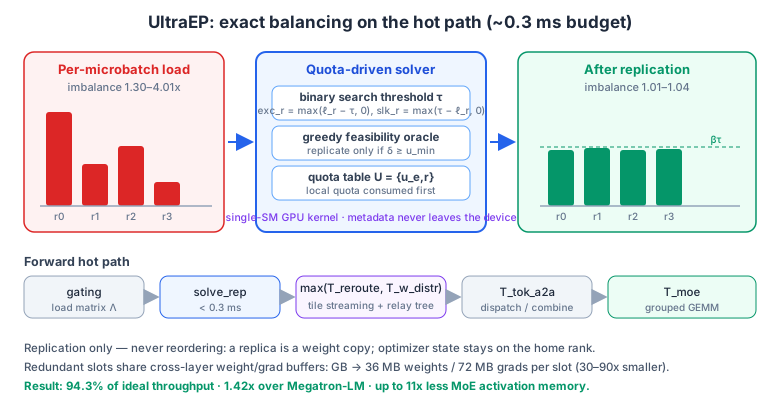
1. The EP Straggler Problem
At 32-way or 64-way expert parallelism, minor routing fluctuations amplify into system-level stalls. The failure shows up in four coupled ways:
- Device-level load skew. Inter-rank imbalance ratios routinely reach 1.30–4.01x without intervention.
- Compute stragglers. The overloaded GPUs hold the global synchronization barrier hostage.
- Token all-to-all bottlenecks. Congestion on the interconnect during dispatch/combine.
- Memory spikes. Receive-side hotspots create activation memory spikes up to 11x higher than ideal.
Why periodic and predictive balancing fails
Historical methods like EPLB adjust placement from stale statistics. In fine-grained MoE, popularity drifts fast enough that a stale plan doesn’t merely leave residual imbalance — it frequently introduces new stragglers, because it optimizes for a traffic pattern that has already vanished. The only way to reach near-ideal throughput is exact-load balancing computed from the load matrix of the microbatch you are about to run.
The RSN connectivity enabler
What makes this affordable is the Rack-Scale Node (RSN). Standard RDMA clusters do packet-based networking at tens of GB/s; RSNs extend scale-up connectivity across dozens of GPUs at hundreds of GB/s with load/store memory semantics — the same shift analyzed in NCCL GIN & MSCCL++ and Inside TPU and GPU Clusters. Concretely, it buys a latency budget of about 0.3 ms for hot-path balancing (planning plus replication). With the entire EP group inside one high-bandwidth domain, real-time per-microbatch balancing becomes physically viable for the first time.
2. Architecture and Memory Co-Design
Balancing gains are easy to erase with system overhead, so UltraEP co-designs the memory layout with the execution pipeline.
Logical vs. physical experts
UltraEP separates logical experts (model identity) from physical experts (on-device instances). Each rank reserves fixed main slots for persistent logical experts and transient redundant slots for replicas, giving a deterministic one-to-many mapping.
The “replication-only” mandate
UltraEP deliberately refuses to reorder experts. At large EP, where a rank hosts only 2–4 main experts, full state migration is prohibitive: reordering means updating global routing tables and migrating persistent optimizer states. Replication needs only a weight copy to expand capacity, leaving the home instance and its optimizer state untouched. This is the same asymmetry that makes Megatron Core’s MoE training path conservative about placement changes mid-run.
Cross-layer buffer reuse
Redundant slots store no optimizer state; weight and gradient buffers are shared across layers. For a model like Qwen3-235B, this shrinks a redundant slot from gigabytes to 36 MB of weights / 72 MB of gradients — a 30x to 90x reduction. Redundancy becomes cheap enough to use aggressively.
Execution pipeline and the ring buffer
The forward pass does eager planning immediately after gating, then weight distribution. The backward pass re-materializes weights and reduces gradients from replicas back to main experts. UltraEP uses torch.autograd to carry a virtual layer ID that indexes a ring buffer whose size is matched to the maximum number of in-flight microbatches. That single trick makes the scheme compatible with pipeline parallelism and virtual PP without the balancer needing to know anything about the PP schedule.
3. The Optimization Formulation
| Symbol | Meaning |
|---|---|
| $R$ | All ranks in one EP group |
| $E$ | All logical experts |
| $h(e)$ | Home rank of logical expert $e$ |
| $H(e)$ | Set of ranks hosting physical instances of $e$ |
| $N_{\text{slot}}$ | Redundant slots per rank |
| $\Lambda = {\lambda_{r,e}}$ | Global load matrix (tokens from rank $r$ to expert $e$) |
| $U = {u_{e,r}}$ | Solved load quota table |
| $\beta$ | Target balancing coefficient (default $1.01$) |
The objective is to minimize the exposed path latency of the busiest ranks:
\[T_{\text{fwd}} = \text{solve_rep} + \max(T_{\text{reroute}}, T_{\text{w_distr}}) + T_{\text{tok_a2a}} + T_{\text{moe}}\] \[T_{\text{bwd}} = T_{\text{tok_a2a}} + T_{\text{moe}}\]Compute latency is set by the most loaded rank:
\[T_{\text{moe}} \propto \max_{r \in R} \sum_{e \in E} u_{e,r}, \qquad T_{\text{bwd,moe}} \approx 2\,T_{\text{fwd,moe}}\]with the factor of two accounting for Wgrad and Dgrad. Token all-to-all is bounded by the worse of a rank’s send and receive volume:
\[T_{\text{tok_a2a}} \propto \max_{r \in R} \max\left(\sum_{e \in E} \lambda_{r,e},\ \sum_{e \in E} u_{e,r}\right)\]And weight distribution captures the fan-out bottleneck at whichever rank happens to host the hottest main experts:
\[T_{\text{w_distr}} \propto \max_{r \in R} \sum_{e \in E_r} \left(|H(e)| - 1\right)\]That last term is the one people forget: making a hot expert very replicated is itself a communication cost concentrated on one sender, which is exactly what Section 5 goes after.
4. The Quota-Driven Planning Solver
The control plane is simplified by decoupling token-level routing from combinatorial search. Instead of assigning tokens, the solver assigns quotas.
The greedy feasibility oracle
Binary-search the smallest load threshold $\tau$ that can be satisfied. For each rank define excess and slack:
\[\text{exc}_r = \max(\ell_r - \tau,\ 0), \qquad \text{slk}_r = \max(\tau - \ell_r,\ 0)\]Crucially, a replica is materialized only when it carries useful load, governed by a quota floor $u_{\min}$. This is what prevents the pathology of creating replicas that satisfy a placement heuristic while resolving no bottleneck.
Quota decomposition and locality
Once $U$ is solved, source ranks consume their own local expert quotas first before dispatching to remote replicas — cutting cross-rank traffic without violating the solved threshold $\tau$.
Algorithm 1: joint solving
INPUT: Load Matrix Λ, Slot Budget N_slot, Quota Floor u_min, Target β
INITIALIZE: Binary search range [τ_lo, τ_hi]
WHILE τ_lo < τ_hi:
    τ = (τ_lo + τ_hi) / 2
    Identify exc_r (excess) and slk_r (slack) for all ranks.
    FOR each overloaded rank r (descending exc_r):
        FOR each hot expert e on rank r (descending λ_e):
            t* = rank with max slk that does not host e
            δ  = min(exc_r, slk_t*, remaining_load_of_e)
            IF δ >= u_min:
                update exc_r, slk_t*, transfer quota to t*
    IF all exc_r == 0: τ is FEASIBLE; search lower.
    ELSE:              search higher.
OUTPUT: Slot assignment X and Load Quota Table U
GPU-native implementation
To hit the sub-0.3 ms budget, the solver runs as a single-SM kernel: the load matrix is staged in shared memory and reductions are done at warp level, so routing metadata never round-trips to the CPU. This is the same “get the host off the critical path” discipline that dominates modern MoE kernels — see the on-device scheduling in Mixture-of-Kittens and SonicMoE.
5. RSN-Native Balancing Communication
The solver emits a stream of device-resident transfer tasks; communication kernels consume it and saturate RSN bandwidth.
Persistent tile streaming
A persistent device-side kernel executes the weight/gradient transfers. Experts are split into fixed-size tiles; thread blocks pull tiles from the task stream and use one-sided peer-memory access to store directly into remote GPUs. Double buffering folds task lookup and synchronization into the data movement itself.
Chunk streaming relay for hotspot fan-out
When an expert’s replica count exceeds a threshold (set to 4), a naive one-to-many broadcast makes the source rank the bottleneck — precisely the weight-distribution term above. UltraEP builds a two-stage relay tree:
-
Relay frontier. The source seeds a relay set of size $\approx \sqrt{ H(e) - 1}$. - Streaming logic. Relays forward chunks of tiles immediately on arrival, with no global barrier.
- Scheduling. A global greedy heuristic assigns relay roles to ranks with spare sending capacity, so no single rank bottlenecks replication.
| The $\sqrt{\cdot}$ frontier is the standard two-level broadcast trade-off: it balances the source’s fan-out against relay depth, turning an $O( | H(e) | )$ serial send into roughly $O(\sqrt{ | H(e) | })$ exposed time. |
6. Evaluation
Measured at production scale (up to 256 GPUs):
- Throughput. 94.3% of ideal on average; 1.42x over Megatron-LM, and 1.49x over no balancing overall.
- Balance. Inter-rank imbalance flattened from 1.30–4.01 down to 1.01–1.04.
- Replication speed. 3.1x to 5.5x faster than PyTorch Distributed and DeepEP.
- Production. A RefMoE-288B run sustained 92% of ideal throughput with stable convergence.
Memory is the underrated result
Removing receive-side hotspots yields up to an 11x reduction in MoE activation memory for serving prefill. That is arguably more strategically valuable than the throughput number: it is headroom against OOM, and it buys larger batch sizes. In training it lowers activation peaks, letting models scale without paying the recompute tax of frequent activation checkpointing.
Takeaways
- Fine-grained MoE turned balancing into a real-time problem. Statistics-driven placement is not merely suboptimal at this granularity — it actively manufactures stragglers.
- Rack-scale connectivity is what makes exactness affordable. A ~0.3 ms hot-path budget only exists because the EP group sits in one load/store domain.
- Replicate, don’t reorder. Sidestepping optimizer-state migration is the design decision that keeps hot-path balancing tractable, and cross-layer buffer reuse (GB → tens of MB) is what makes redundant slots cheap enough to spend freely.
- Quotas beat token-level search. Binary search over a threshold plus a greedy oracle with a quota floor $u_{\min}$ gives exact balance without combinatorial placement search, and fits in a single SM.
- The memory win may outlast the throughput win. 11x lower activation peaks changes what batch sizes and context lengths are reachable at all.