GLM-5.3-Flash: Hybrid Attention, IndexPool, and Vision-in-the-Loop
Reading notes on:
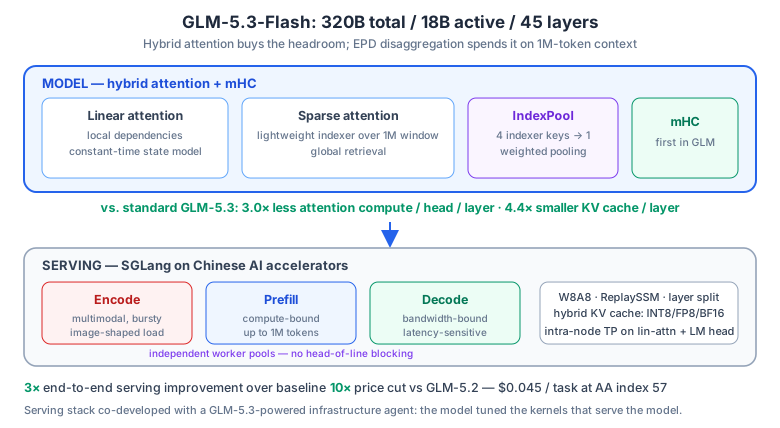
The interesting number in the GLM-5.3-Flash release is not a benchmark score. It is $0.045 per task at an Artificial Analysis Intelligence Index v4.1.1 score of 57 — a claimed 10× price reduction relative to GLM-5.2 while staying inside striking distance of the frontier. The model is also the first natively multimodal member of the GLM-5 family, trained on a 30T-token multimodal corpus.
Three things get it there, and they are worth separating because they operate at different layers of the stack:
- Architecture — fewer active parameters, fewer layers, hybrid linear + sparse attention, and mHC.
- Capability — “vision-in-the-loop,” where the model looks at what it rendered and reacts.
- Systems — a serving stack co-designed for Chinese AI accelerators, with EPD disaggregation for 1M-token contexts.
This lands one day after Qwen3.8-Flash-Next, which makes almost the same argument from the pre-training side. Two labs, one week, one thesis: the frontier is moving down the cost axis, not up the parameter axis.
1. Architectural Slimming
| Metric | GLM-4.5 | GLM-5-Base | GLM-5.3-Flash |
|---|---|---|---|
| Total parameters | 355B | 744B | 320B |
| Active parameters | 32B | 40B | 18B |
| Layers | 92 | — | 45 |
Halving both active parameters (18B vs 32B) and depth (45 vs 92) attacks decode cost from two directions at once. Active parameters set the per-token weight-read volume; layer count sets the number of sequential dependent steps, and therefore how much of the decode is latency-bound rather than bandwidth-bound. The token economics roofline makes the arithmetic explicit: for memory-bound decode, halving both roughly quarters the critical-path cost per token, which is where a 10× price cut starts to look reachable once you add batching and quantization.
The model was validated in the wild before its official debut — it ran anonymously on OpenCode and OpenRouter under the pseudonym “ox-alpha” and placed as a top-tier performer.
Prior GLM notes for context: GLM-5, GLM-5.2, and GLM-5.3’s post-training story.
2. Hybrid Attention: Linear State + Sparse Retrieval
A 1M-token context window is unreachable with dense attention at any price. GLM-5.3-Flash bifurcates the mechanism:
- Linear attention models local dependencies via state modeling — constant-time per token with respect to sequence length, handling the immediate context.
- Sparse attention acts as the global retriever, using a lightweight indexer to pull the relevant slices out of the full 1M-token window.
This is the same two-tier decomposition as the GDN + QSA hybrid in Qwen3.8-Flash-Next and the DSA indexer in DeepSeek-V3.2. The field has converged hard on “cheap recurrent state for what’s near, learned sparse retrieval for what’s far.”
mHC arrives in GLM
For the first time in the GLM series, the model adopts Manifold-Constrained Hyper-Connections (mHC) to improve scaling efficiency — more intelligence per unit compute by widening and constraining the residual stream. I covered the mechanism in Manifold-Constrained Hyper-Connections; the related design space includes Residual Matrix Transformers and Attention Residuals. Notably, Qwen3.8-Flash-Next explicitly dropped the cross-branch mixing operator that mHC-style designs use, finding no downstream gain for substantial memory traffic. Two labs, same primitive, opposite conclusion on the mixing term — worth watching.
IndexPool
Sparse attention buys compute savings but reintroduces a cost: the indexer itself has to hold key state for the whole window. At 1M tokens the indexer’s memory footprint and latency become the new bottleneck.
IndexPool compresses four indexer key vectors into one via weighted pooling. Same idea as QSA’s $r=4$ average-pooled key blocks, but with learned weights rather than a plain mean — and the same payoff: retrieval accuracy is preserved because block-level relevance is a low-frequency signal, while the state you must keep resident drops $4\times$. The cross-layer variant of this trick is IndexCache.
Against the standard GLM-5.3 baseline, the combination yields:
- 3.0× reduction in attention compute per head per layer.
- 4.4× reduction in KV cache size per layer.
Achieving the lowest attention compute among compared models is what creates the headroom to pay for native multimodality and 1M-token stability in the same budget. Cheap attention is not the goal; it is the funding source.
3. Vision-in-the-Loop
The multimodal claim here is narrower and more useful than “the model can see images.” It targets agentic workflows in code and GUI environments, where visual output is a feedback signal, not an input modality.
The motivating observation: in frontend development, game design, and 3D simulation, logical correctness is insufficient. Layout shifts, z-index collisions, and interactive glitches only exist once something renders. A text-only coding model is debugging blind.
Vision-in-the-loop lets the model observe its own rendered output and use that observation to choose the next action. Because vision is native rather than bolted on via a separate captioning call, the model decides when to look — which is the part that matters for cost, since a screenshot is expensive in tokens and most steps don’t need one.
Three training pipelines back it, all supported by the 30T-token multimodal corpus:
- Self-visual judgment — the model is trained to inspect its own visual outputs and iteratively refine interfaces and simulations.
- RL with environment feedback — strengthening navigation of real user flows, in the same spirit as the world-model objectives in ECHO.
- Agent-based verification — GUI judgment grounded in actual user interactions, pushing validation past functional correctness into aesthetic and interactive quality.
The downstream consequence is that heterogeneous visual and structured context — spreadsheets, dashboards, charts — can be reasoned over directly from the artifact, without a lossy textual transcription step. Architectural comparison points: Gemma 4 and DeepSeek-OCR 2.
4. Hardware–Software Co-Design for Chinese Accelerators
The systems section is the part most likely to be under-read, and it is the most consequential. GLM-5.3-Flash is optimized for the memory-capacity and bandwidth constraints of Chinese AI chips — reaching, per the report, parity with mainstream global hardware on efficiency and per-token cost. This is the same genre of constraint-driven engineering as LongCat-2.0 on AI ASICs and DeepSeek-V3’s hardware-aware design.
The serving stack
Built on SGLang, with:
- Intra-node tensor parallelism applied to linear attention and the LM head — the two places where TP pays off without inflating collective traffic per token.
- ReplaySSM and W8A8 quantization, cutting the memory footprint.
- Hybrid cache quantization — INT8 / FP8 / BF16 chosen per-tier for the KV cache, rather than one global precision. Related precision tradeoffs: open-source quantization strategies and MXFP8 training.
- Layer split, distributing workloads to maximize cluster throughput.
There is a recursive detail worth flagging: development was accelerated by a GLM-5.3-powered infrastructure agent that helped engineers write kernels, diagnose performance bottlenecks, and tune the serving stack. The model optimized the infrastructure that serves the model. That loop is exactly the subject of Harness Engineering for Self-Improvement, Jeff Dean’s YC 2026 talk, and the CUDA Agent work — and the compiler-side version of it is Cake.
EPD disaggregation
To serve 1M-token contexts, the system runs a production-grade Encode–Prefill–Decode (EPD) disaggregated architecture: separate worker pools for multimodal encoding, prefill, and decode.
The systems rationale is head-of-line blocking. Prefill and decode already have wildly different arithmetic intensities and latency profiles — that’s the classic argument for prefill/decode disaggregation. Multimodal encoding adds a third profile: bursty, image-shaped, and unrelated to token count. Colocate all three and a single 1M-token prefill (or one large image batch) stalls every latency-sensitive decode sharing the device. Separate pools mean each stage is scheduled against its own SLO and scaled against its own bottleneck. Further reading: Nvidia’s disaggregated decode and the state of scaling LLM inference.
Net result: 3× end-to-end serving improvement over the initial baseline.
5. Benchmarks
On high-effort coding under Z.ai Code Bench v1.0 (evaluated on the Claude Code 2.1.207 harness), GLM-5.3-Flash scores 29.0 against Claude Opus 4.8’s 29.5 — effectively a tie on the hardest coding suite in the set. The harness dependence of that number is itself a topic; see Claude Code Inflection Point and Meta-Harness.
| Category | Metric | GLM-5.2 | GLM-5.3-Flash | Claude Opus 4.8 | GPT-5.6 Terra | Gemini 3.7 Flash |
|---|---|---|---|---|---|---|
| Coding | DeepSWE v1.1 | 46.2 | 63.4 | 58.0 | 69.6 | 65.3 |
| Coding | Terminal Bench 2.1 | 81.0 | 84.3 | 85.0 | 87.4 | 85.8 |
| Coding | NL2Repo | 48.9 | 56.3 | 69.7 | – | – |
| Agentic | AutomationBench v1.0.6 | 26.2 | 48.8 | 41.0 | 37.2 | 52.3 |
| Agentic | Toolathlon Verified | 59.9 | 78.4 | 76.2 | 74.9 | – |
| Agentic | Agents’ Last Exam | 20.4 | 26.3 | 27.0 | 28.0 | – |
| Vision | MMVU | – | 80.5 | 67.4 | 75.8 | 82.3 |
| Vision | MVbench | – | 77.8 | 67.1 | 75.0 | 82.2 |
Reading the table honestly:
- The generational jump is real. DeepSWE 46.2 → 63.4 and AutomationBench 26.2 → 48.8 are not tuning artifacts.
- Agentic is the strongest suit. Toolathlon 78.4 and AutomationBench 48.8 beat Opus 4.8 outright, which is consistent with vision-in-the-loop paying off most where the environment renders something.
- NL2Repo is the clear gap (56.3 vs 69.7). Whole-repository synthesis is the workload that most rewards active parameters and depth — exactly what an 18B-active, 45-layer model economized away. The same shape of gap shows up as MATH in the Qwen3.8-Flash-Next results.
- Vision beats Opus by a wide margin but trails Gemini 3.7 Flash, which remains the multimodal reference point.
6. Takeaways
- Cheap attention is a funding mechanism. The 3.0× attention-compute and 4.4× KV-cache reductions aren’t the product; they’re what pays for native multimodality and a 1M-token window in the same budget.
- IndexPool generalizes. Any learned sparse-attention indexer carries state proportional to context length, and block-level relevance is low-frequency enough to pool. Expect $r=4$-ish pooling to become standard equipment.
- EPD is the natural successor to PD. Once a third stage with its own latency profile enters the serving path, two-way disaggregation stops being sufficient.
- Co-design now includes the agent. A model tuning its own serving stack is no longer a thought experiment; it shipped, and it’s cited as a reason the stack got 3× faster.
- Where the slimming shows. Both this model and Qwen3.8-Flash-Next lose exactly where you’d predict from first principles — long-horizon symbolic and whole-repository work. Cost-frontier models are not uniformly cheaper; they are cheaper with a specific, legible capability shadow.