Perplexity and Intelligence: What Pretraining Loss Can Tell Us
Reading notes on:
- Perplexity and Intelligence by Jakub Pachocki
GPT-3.5 scored 0.986 and GPT-6.2 Astra scored 0.761 on the same held-out snapshot of OpenAI’s internal codebase. Those numbers measure next-token prediction, yet the models span a change from fluent conversation to solving open problems in mathematics. Pachocki argues that a stable measure of pretraining progress could help labs decide when to expand capability testing and when to pause development until oversight catches up.
1. What log-perplexity measures
To score a base model, give it each prefix from a held-out corpus and record the probability it assigns to the actual next token. Using natural logarithms gives the average cross-entropy loss in nats per token. Perplexity is the exponential of that loss.
\[L = -\frac{1}{N}\sum_{i=1}^{N} \log p_\theta(x_i \mid x_{<i}), \qquad \mathrm{PPL} = \exp(L).\]Perplexity is the reciprocal of the geometric mean probability assigned to the observed tokens. A loss reduction of 0.1 nats therefore raises that geometric mean by about 10.5%. The compression connection comes from coding theory. With a model-based sequence code, a token assigned probability $p$ contributes about $-\log_2 p$ bits once coding overhead is amortized. A predictor that assigns higher probabilities to unseen data can encode it with fewer bits. That gives a concrete interpretation to the loss curves in The Architecture of Scaling Laws.
2. What changed as the loss fell
Using a fixed code snapshot lets OpenAI compare successive generations even when the task benchmarks change. Pachocki traces the progression from coherent paragraphs with GPT-2 to learning from examples in the prompt with GPT-3. On the current evaluation, GPT-3.5 supported fluent conversation at about 0.99, and GPT-4 could use chain-of-thought prompting productively at about 0.91. OpenAI reports stronger capabilities in mathematics and cybersecurity below 0.80. When the lab switched to a model near 0.76, it began seeing solutions to open math problems it had been using as evaluations.
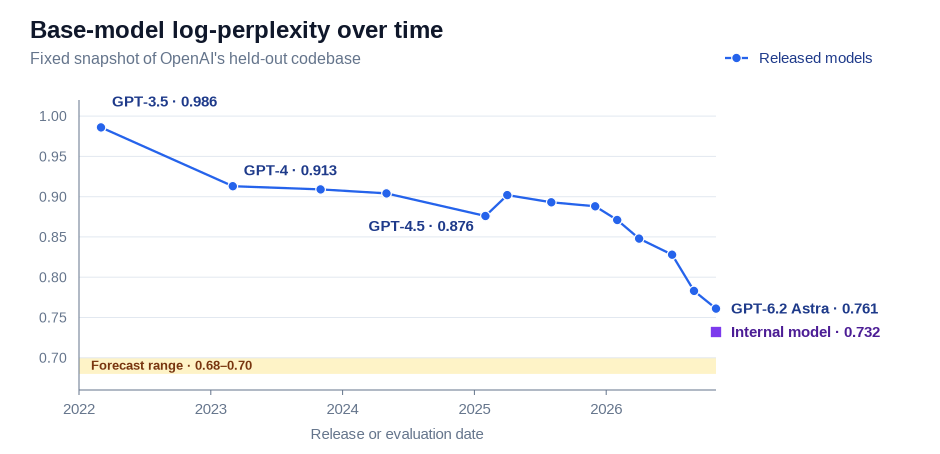
The chart uses release or evaluation dates and values from OpenAI’s interactive figure.
The plotted loss briefly rises after GPT-4.5, then falls fastest in 2026. OpenAI attributes most of that acceleration to earlier investments in research and compute, with automation contributing a smaller share. Pachocki sees a possible change in 2027 if models begin making fundamental advances in pretraining research itself. He also singles out 0.68–0.70 as a range where further capabilities could emerge. That range is an extrapolation on OpenAI’s evaluation, and the historical pairings leave the timing and identity of future capabilities open.
3. What a cross-lab comparison would require
The evaluation corpus defines the score. OpenAI points out that an internal codebase is a poor proxy for the general capabilities of GPT-2 and GPT-3, given their training mixtures. Even on identical raw text, loss per token varies with how the tokenizer segments the text. A comparison across tokenizers can use bits per byte, the total negative log probability in bits divided by the number of raw bytes. A shared protocol would still need common evaluation data, rules for context and document boundaries, and checks for training overlap. Microsoft’s results illustrate how to report several domains on the same byte scale. MAI-Base-2 pretraining notes
The mean can hide where the model improved. A drop in aggregate loss can come from better prediction of common tokens, hard examples, or a mix of both. Per-domain or per-document results would reveal more of that distribution. The irreducible loss floor is also unknown and depends on the data and the context available to the model. Reading changes near that floor would require evidence about which predictions improved.
The base-model score holds the inference setup fixed. More reasoning time, post-training, or tools can improve task performance at a given pretraining loss. That makes loss a way to track the base model while task evaluations measure what the deployed system can do under specified conditions. Reasoning effort and inference scaling
4. What would justify crossing a limit?
Pachocki proposes that frontier labs agree on an initial development limit using perplexity alongside other measurements. Before crossing it, labs would need to demonstrate a concrete advance in oversight, such as a successor to chain-of-thought monitoring. He also calls for shared standards for evaluating models, stress-testing safety cases and disclosing results. The proposal leaves the numerical limit and the evidence needed to cross it for labs to agree on. Perplexity and Intelligence
Chain-of-thought monitoring gives a concrete example of why both measurements matter. OpenAI’s related study found that models with lower base-model perplexity performed better on tasks without a written reasoning trace. That result suggests a monitor that depends on reading the trace may have less evidence to work with as models improve. A successor would need to show directly that it can detect the behavior of concern under those conditions. OpenAI’s study of chain-of-thought monitorability
Takeaway
A shared loss series could tell labs when to re-run capability and oversight evaluations. The hard part of the proposal is agreeing in advance on what those evaluations must demonstrate before training proceeds.