Kimi K3 Architecture, Derived: Why SiTU-GLU, One RMS Norm, and NoPE Work
Reading notes on:
- Jianlin Su (2026), 简单谈谈K3的MoE和Attention
This is a companion to the Kimi K3 systems overview. That note surveyed the full stack — attention, MoE, MoonEP, post-training, serving. This one zooms in on the why: Jianlin Su’s first-principles reading of three design choices that look arbitrary until you do the math. The unifying theme of K3 is compact:
\[\text{K3} = \text{KDA} + \text{MLA} + \text{Stable LatentMoE} + \text{AttnRes},\]trained with a Moonlight-style Muon whose attention weights are optimized per head, decoupling head-to-head interference (the per-head Muon connects to the optimizer story in SOAP, Muon, and Beyond).
1. SiTU-GLU: Killing the $\mathcal{O}(|x|^4)$ Outlier
Standard FFN/MoE experts use SwiGLU:
\[\text{SwiGLU}(x) = W_3\big(\text{SiLU}(W_1 x) \odot W_2 x\big), \qquad \text{SiLU}(x) = x\,\sigma(x).\]The blow-up mechanism. SiLU is the nonlinearity, and it is unbounded on the positive side. When $|x|$ is large and a row $w_1$ of $W_1$ nearly aligns with $x$, the inner product $w_1\cdot x$ becomes huge; since $\sigma(w_1\cdot x)\to 1$, the gate output $\text{SiLU}(w_1\cdot x)$ grows linearly in $|x|$, i.e. $\mathcal{O}(|x|)$. The danger is coincidence: if the corresponding row of $W_2$ also aligns with $x$ at the same channel, then
- $\text{SiLU}(W_1 x)$ on that channel is $\mathcal{O}(|x|)$,
- $W_2 x$ on that channel is $\mathcal{O}(|x|)$,
- their Hadamard product is $\mathcal{O}(|x|^2)$,
and once projected by $W_3$ and cascaded through subsequent nonlinear layers, the effect amplifies to $\mathcal{O}(|x|^4)$-level extremes — numerical collapse and training instability.
The fix — SiTU-GLU. K3 first designs a Sigmoid Tanh Unit gate that softcaps the magnitude:
\[\text{SiTU}(x;\beta) = \text{softcap}(x;\beta)\cdot\sigma(x), \qquad \text{softcap}(x;\beta) = \beta\tanh\!\left(\tfrac{x}{\beta}\right),\]bounding the gate to $(-\beta,\beta)$. To fully eliminate inflation it softcaps the other GLU branch too:
\[\text{SiTU-GLU}(x) = W_3\big(\text{SiTU}(W_1 x;\beta_1)\odot\text{softcap}(W_2 x;\beta_2)\big),\]with $\beta_1 = 4$, $\beta_2 = 25$ — so the product is bounded by $\beta_1\beta_2 = 100$. Unlike a hard clip (GPT-OSS, DSV4), the $\tanh$ softcap is continuous and everywhere differentiable, giving cleaner gradient flow and better convergence at the same numerical ceiling.
2. Stable LatentMoE: Why a Single RMS Norm Is Magic
The structure. LatentMoE adds dimensionality reduction around the expert bank so it can double the expert count at fixed FLOPs:
- Traditional MoE: $d \xrightarrow{\text{route/gate}} D \to d$ (pick $k$ of $n$ experts).
- LatentMoE: $d \xrightarrow{\downarrow} d/2 \xrightarrow{\text{route/gate}} D \to d/2 \xrightarrow{\uparrow} d$ (pick $2k$ of $2n$).
The projection to $d/2$ frees channel budget, so the expert count doubles ($2n$-choose-$2k$) at essentially unchanged compute.
The instability. Naive LatentMoE makes down- and up-projection pure linear maps, so the forward path stacks four matmuls in series ($W_{\text{down}}\to W_{\text{gate/up}}\to W_{\text{down_exp}}\to W_{\text{up}}$) with MoE routing sandwiched in the middle — a recipe for exploding/vanishing gradients.
The fix — one RMS Norm before up-projection. K3 ablated norms at two sites (after down-projection, before up-projection) and found the pre-up-projection norm is the essential one. By the minimal-change principle, K3 keeps only that single norm. Why does one weak norm do so much? Jianlin Su lists six reinforcing effects:
- Auto-balances shared vs. routed experts. No hand-tuned scaling factor needed; the mixing ratio self-balances in feature space.
- Adds effective depth. Even a weak nonlinearity breaks the pure-linear series, raising the local effective nonlinear depth of the block.
- Removes geometric distortion. Normalizing latents onto the unit hypersphere makes Top-$K$ routing depend on angle/direction, not magnitude — no large-norm token hijacking the routing space.
- Mitigates expert skew. Constraining the RMS scale into each expert suppresses winner-take-all over-activation and representation collapse.
- Promotes subspace orthogonalization. It pushes experts to fit near-orthogonal, non-overlapping basis directions on the sphere — a near-orthogonal union of subspaces — cutting collinear redundancy across up-projection matrices.
- Smooths discrete-routing gradients. The normalized gradient is approximately $\frac{\partial\mathcal L}{\partial W} = g\big(h/|h|_{\text{RMS}}\big)^\top$, decoupling step size from $|h|$ and damping the oscillation from hard Top-$K$ switching.
3. Quantile Balancing: A Histogram Trick for 896 Experts
With LatentMoE, K3 routing goes from 448-choose-8 to 896-choose-16 — same sparsity, but double the experts, which sharply worsens multi-node load imbalance. K3 keeps K2’s loss-free balancing but replaces the SignSGD-style bias update (unstable at 896 experts) with Quantile Balancing (QB): a more principled rule with zero extra hyperparameters.
The catch: QB needs a global quantile of activation scores, and quantiles are nonlinear and non-additive — an exact global sort would cost enormous cross-node communication. The fix is a histogram estimator:
- Map scores into $[0,1]$;
- Keep a local $B$-bin frequency histogram;
- Aggregate across nodes — histograms are additive, so a single all-reduce of a length-$B$ vector reconstructs the global distribution and hence the quantile;
- 1000 bins give the same load-balancing benefit as 10000 in practice — so 1000 is the production default.
4. Attention: The Grail, and Why MLA Still Wins
Absent MTP, “under equal training and inference cost, MLA is likely the best full-attention variant.” But Multi-Token Prediction (MTP) trades compute for decoding speed, and MLA’s decoding behaves like $\text{head_dims}=512{+}$ MQA — it front-loads most of the compute, so an “MLA + MTP” combo can be compute-heavy and lose out. Across the main alternatives, though, MLA still wins on balance:
| Variant | Config | KV cache | Train / prefill cost | Trade-off |
|---|---|---|---|---|
| MLA | 192+128 (MHA) | very low | low | heavier decode compute; less MTP-friendly |
| GQA8 | 128+128 | >3× MLA | low | loss hard to beat MLA |
| MFA | 256+256 (MQA) | ≈ MLA | very high | prefill compute explodes (bad for agent/coding) |
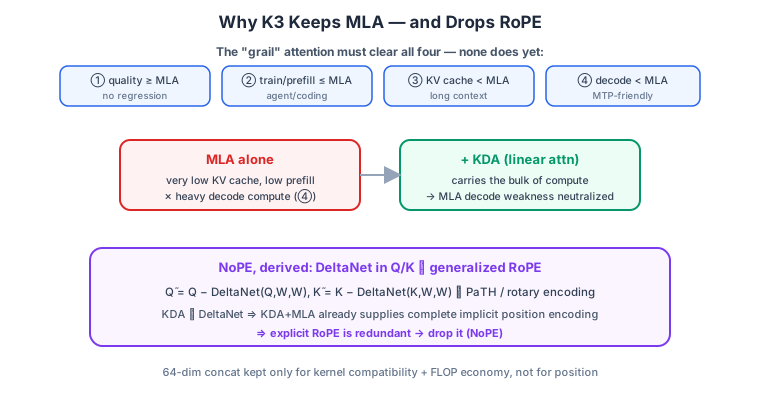
A “grail” attention that truly beats MLA must simultaneously: (1) match MLA quality; (2) not exceed MLA’s train/prefill cost; (3) have smaller KV cache; (4) have smaller decode compute (MTP-friendly). No single architecture clears all four today — but because KDA (linear attention) already carries the bulk of the compute in K3’s hybrid, MLA’s decode-compute weakness is largely neutralized, so K3 keeps MLA.
DSV4 is MLA pushed to an extreme. DeepSeek V4 nominally drops MLA for $\text{head_dims}=512$, $K=V$ MQA with QKVO-RoPE — but that is essentially MLA’s decoding form. Pure MQA blows up train/prefill compute, so DSV4 must bolt on sparsity and KV compression to amortize it. DSV4 doesn’t overturn MLA; it pushes it to the other extreme via heroic infra (see DeepSeek-V4 and its TensorRT-LLM Blackwell serving).
5. NoPE, Derived: KDA Supplies a Complete Generalized RoPE
K3 keeps standard MLA but removes RoPE entirely — pure NoPE. In an all-MLA model (like K2) dropping RoPE wrecks long-context and position sensitivity. K3 can drop it because of the KDA + MLA hybrid, and the reason is a clean equivalence.
By the completeness analysis of rotary encodings, any power of an orthogonal matrix can serve as a generalized RoPE. Under an orthogonal constraint, the Householder-based PaTH architecture rewrites exactly as a softmax attention on transformed queries/keys:
\[\text{SoftmaxAttention}(\tilde Q, \tilde K, V), \quad \tilde Q = Q - \text{DeltaNet}(Q, W, W), \quad \tilde K = K - \text{DeltaNet}(K, W, W).\]So applying a DeltaNet transform to $Q$ and $K$ is mathematically equivalent to injecting a generalized RoPE / PaTH position encoding. Since KDA is strictly more general and expressive than DeltaNet, the KDA + MLA hybrid already provides implicit, complete generalized position encoding at the system level. Explicit RoPE in the MLA layers becomes redundant — NoPE keeps the same quality while simplifying the MLA path.
Then why still concatenate an extra 64 dims? If RoPE is gone, why does K3’s MLA still splice a 64-dim latent?
- Infra compatibility — reuse the existing high-performance MLA CUDA/Triton kernels; no need to rebuild the operator base.
- Compute economy — projecting a full 576-dim latent and then separate $192{+}128$ $K$/$V$ looks cleaner in code but wastes projection FLOPs for zero accuracy gain.
- Variable control — K3 already introduces KDA, AttnRes, and more; keeping the mature MLA layer minimally changed maximizes training robustness.
6. The Design Philosophy: Elegant Trade-offs Under Hard Constraints
The throughline of K3 — and of Jianlin Su’s reading of it — is that architecture progress is rarely a single theoretical revolution. It is systematic trade-off under extreme engineering constraint: the target may be an idealized perfect architecture, but each production generation must find the most stable balance among quality, training cost, inference throughput, and algorithmic stability. SiTU-GLU bounds an $\mathcal{O}(|x|^4)$ outlier with one softcap; a single RMS Norm stabilizes a four-matmul chain and buys six free benefits; NoPE falls out of a DeltaNet↔RoPE equivalence rather than a hack. Same lesson as the systems overview’s takeaway — bounding the unbounded — seen this time from the derivation side.