DeepSeek-V4 on Blackwell: Model-Specific and Agentic Optimizations in TensorRT-LLM
Reading notes on:
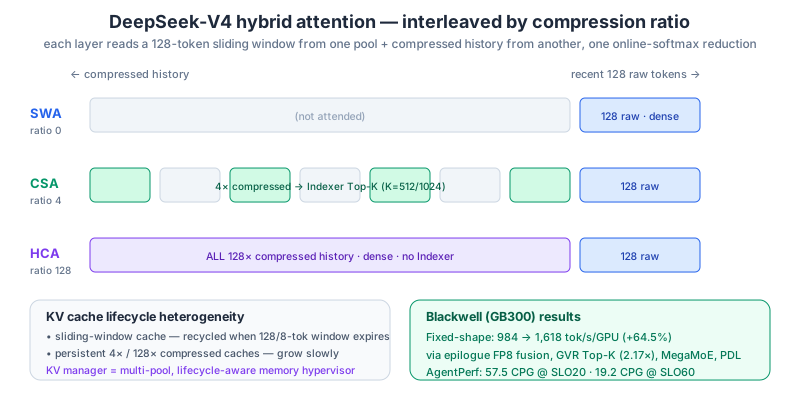
This is the serving-side companion to DeepSeek-V4’s architecture and training write-ups — see DeepSeek-V4 Architecture & Training and DeepSeek-V4 Infra. NVIDIA’s co-design targets both fixed-shape throughput and dynamic, multi-turn agentic workloads on GB300. Through kernel fusions, algorithmic tricks like Temporal Correlation Top-K (GVR), and multi-level KV-aware routing, they reached a 64.5% throughput increase for fixed-shape work (984 → 1,618 tokens/s/GPU), and 57.5 CPG at SLO20 / 19.2 CPG at SLO60 on Artificial Analysis AgentPerf.
1. DeepSeek-V4 Architectural Paradigms
Two variants: Flash (284B total / 13B active) and Pro (1.6T total / 49B active). TensorRT-LLM natively implements the heterogeneous sublayers.
Hybrid attention (SWA, CSA, HCA) — interleaved by a layer’s compression ratio:
- SWA (ratio 0): dense attention over the most recent 128 raw tokens.
- CSA (ratio 4): recent 128 raw tokens + 4× compressed history; an Indexer selects entries via Top-K (K=512 Flash, 1024 Pro).
- HCA (ratio 128): 128 raw tokens + all 128× compressed history, densely, no Indexer.
TensorRT-LLM uses a unified dual-pool MLA kernel: it processes the 128-token window from one pool and compressed entries (Top-K for CSA, full stream for HCA) from a second, combining both in a single online-softmax reduction. A per-query topk_lens vector drives the variable workload while fixed-width index buffers preserve CUDA Graph compatibility. This is the same sparse-attention lineage explored in IndexCache: Cross-Layer Index Reuse.
Online Sequence Compressor — token-level, softmax-gated pooling produces history for CSA/HCA. Each token’s projected KV entry gets a learned compression-weight vector plus a position bias; the group reduces to one entry via a softmax-weighted sum. CSA uses window $m=4$ (overlapping, $2m$ receptive field, dual streams for main KV and Indexer keys); HCA uses disjoint $m’=128$ windows.
mHC (Manifold-constrained Hyper-Connections) — every attention/MoE sublayer is wrapped in an mHC module that expands the residual stream 4×, mixes it via a doubly-stochastic matrix (20 Sinkhorn-Knopp iterations), and writes back through a post-mapping; an HC head collapses the stream before the LM head.
MoE — 6 routed + 1 shared expert per token out of 256 (Flash) / 384 (Pro). Layers 1–3 use deterministic hash routing; deeper layers use a learned gate with Sqrt-Softplus affinities and a score-correction bias.
Cache lifecycle heterogeneity — sliding-window cache (SWA KV + short-lived compressor state, recyclable when the 128- or 8-token windows expire) vs. persistent compressed caches (4× and 128× finalized entries that grow slowly). This extends the hybrid KV-cache theme from DeepSeek-V4 Infra.
2. Part I — Micro-optimizations & Kernel Fusions (Fixed-Shape)
To hit 1,618 tokens/s/GPU on the 8K/1K InferenceX workload:
- FP8 dataflow: for Pro, inverse RoPE and 1×128 E4M3 quantization are fused into the FMHA correction epilogue, writing FP32 scales and E4M3 outputs directly for the
o_a_projBMM — the epilogue-fusion philosophy of CODA applied in production. - Top-K via GVR (Gated Value Retrieval): exploits temporal correlation — reuse the previous step’s indices as candidates, refine against current scores. Up to 2.17× speedup over radix-selection.
- Multi-stream overlap: the CSA prologue launches the main-attention Compressor and query-independent Indexer early on dedicated streams, overlapping shared projections and Q norms.
- mHC fusion: adjoining post-mappings and pre-mappings fuse into shape-specialized FMA/MMA kernels; the next sublayer’s RMSNorm folds into the fused epilogue, removing a memory round-trip.
- DeepGEMM MegaMoE: symmetric memory + in-kernel sync fuse dispatch, twin expert GEMMs, SwiGLU, and combine (MXFP8 activations × MXFP4 weights); input prep collapses from 6 ops to 1.
- SWA scratch reuse and PDL (Programmatic Dependent Launch): a consumer grid launches before its producer retires, eliminating host-device boundaries.
3. Part II — Agentic Workloads (Multi-Turn, High-Reuse)
AgentPerf measures Concurrency Per GPU (CPG) under TTFT and decode-speed SLOs. Heavy prefix reuse moves the bottleneck from raw throughput to routing, cache lifecycle, and control-plane serialization.
Two-level context-locality routing — prefix reuse only helps if turns hit the exact worker/rank holding the KV.
- Instance-level (CTX servers): map stable session IDs to servers; for unknown sessions, incremental tokenization + a block-match score penalized by load, so shared system prompts don’t dilute conversation-specific routing.
- Rank-level (ADP ranks): ranks probe local radix trees with a cache salt; score
(Total Input − Matched Prefix) + Load Penalty, so long cached prefixes trump generic load-balancing unless a rank hits capacity.
Cache lifecycle tuning — the bug: sliding-window state was retained for the entire prompt history across turns and CTX→GEN transfers. The fix: a per_request policy that drops sliding-window blocks older than the active window on completion/transfer.
Eradicating host overhead — with minimal GPU work on cached prefills, Python control-plane tasks dominate TTFT. Fixes: packed block-level C++ hashing, skipping collectives when no tasks pend, no re-tokenization (CTX forwards IDs), removed deep copies, and replacing Python JSON with pydantic-core / msgspec MessagePack to bypass GIL-bound serialization.
4. Insights
- From FLOPs to memory-lifecycle governance: differentiating cache lifetimes (transient 128-token windows vs. persistent 128× compressed history) turns the KV manager from a linear allocator into a multi-pool, lifecycle-aware memory hypervisor.
- System co-design over microbenchmarks: the gains came from preventing GPU starvation (PDL, C++ orchestrator, GVR), not one magic kernel.
- What’s next: a fully C++ KV manager (dropping the GIL under high prefix-reuse), full NVFP4 execution, and native integration of DeepSeek-V4’s DSpark speculative decoding — the block-diffusion / semi-autoregressive drafting analyzed in DFlash & DSpark.