HarnessDev: Can LLMs Create and Evolve Their Own Agent Harness?
Reading notes on:
Every agent benchmark result you’ve ever read is a joint measurement of two things: the model, and the software wrapped around it. The agent harness (the loop that orchestrates tools, bounds context, recovers from failures, and verifies results) has historically been treated as an experimental control, held fixed so the model can be the variable.
HarnessDev flips the variable. It asks whether an LLM can build the harness, and then whether it can maintain one over time. The unit of evaluation moves from a transient task output to runnable, persistent infrastructure.
The headline result is not that models can do this. It’s that they can do it well enough to look impressive under self-evaluation, and then fall apart the moment you check for portability or generalization. This post is mostly about those failure modes, because they are the interesting part.
1. Formalization
\[(L_C, D) \to H, \qquad (H, L_E, x) \to y \xrightarrow{\;J\;} \text{score}\]- $L_C$ (Creator LLM): writes, debugs, and refines the harness code.
- $D$ (Development workspace): where the creator edits files, runs tests, and reads traces (Claude Code or Codex in these experiments).
- $H$ (Runnable harness): the persistent, versioned software system produced by $L_C$.
- $L_E$ (Executor LLM): runs downstream tasks inside the frozen $H$.
- $x$ (Downstream task): an instance from a benchmark family.
- $y$ (Task output): the authoritative artifact: repo patch, model submission, cited text.
- $J$ (Judge): the frozen benchmark-specific oracle.
The decoupling of $L_C$ from $L_E$ is the whole methodological contribution. Everything interesting falls out of setting $L_E \ne L_C$.
Anatomy of a harness
\[H = \langle E, T, C, S, L, V \rangle\]- $E$ (Execution loop): multi-turn control plane, planning phases, scheduling, honest stopping criteria.
- $T$ (Tools): schema registration, interface constraints, I/O parsing, tool-call execution.
- $C$ (Context management): log organization, chat-history assembly, compression/compaction against the context budget.
- $S$ (State & memory): current goals, active hypotheses, progress, attempts, failures, serialization checkpoints.
- $L$ (Lifecycle & recovery): pre/post-action hooks, timeout handlers, process isolation, graceful crash recovery.
- $V$ (Verification & evaluation): automated code checks, verification scripts, self-review, evaluation logs.
Hold onto $S$ and $V$. Those two are where the corpses are buried.
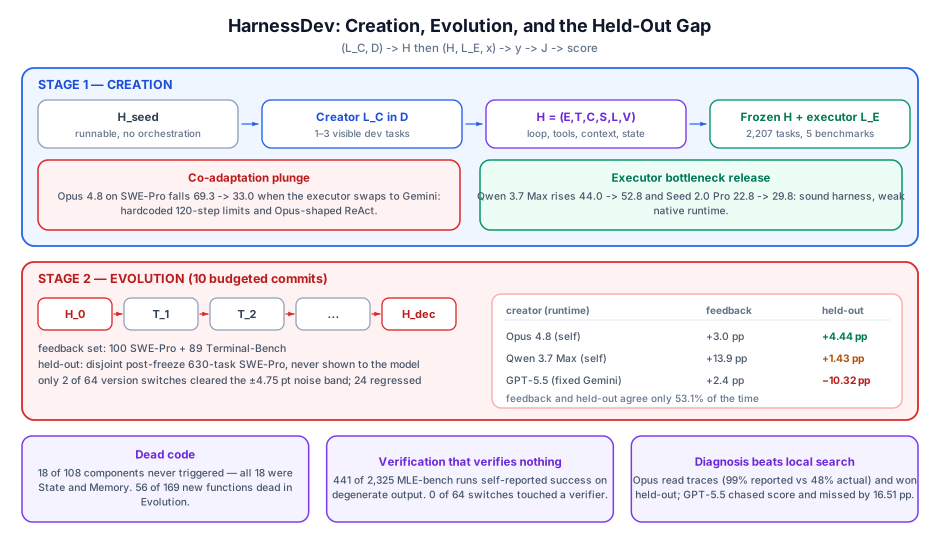
2. Stage 1: Creation (RQ1)
The creator starts from $H_{\text{seed}}$: a deliberately weak but runnable seed that parses CLI arguments and formats output, and implements no task-solving orchestration whatsoever. It scores 0.0 everywhere. From there, using 1–3 visible public development tasks, the model must implement a complete generalized harness.
The frozen result is evaluated two ways:
- Self-Eval: $L_E = L_C$. Tests co-design: a harness tuned to the model’s own capabilities.
- Unified-Eval: $L_E = $ Gemini 3.1 Pro for every harness. Isolates harness quality from executor capability.
Coverage is four domains, five benchmarks, 2,207 unique task instances: SWE-bench Pro (731), Terminal-Bench 2.1 (89), MLE-bench (75), EQ-Bench3 (46), BrowseComp (1,266).
| Creator ($L_C$) | SWE-Pro (Self / Unified) | Terminal-Bench | MLE-bench | EQ-Bench3 | BrowseComp | Average |
|---|---|---|---|---|---|---|
| Seed harness | 0.0 / 0.0 | 0.0 / 0.0 | 0.0 / 0.0 | 0.0 / 0.0 | 0.0 / 0.0 | 0.0 / 0.0 |
| Opus 4.8 | 69.3 / 33.0 | 64.8 / 52.4 | 32.9 / 16.9 | 84.6 / 74.2 | 52.4 / 53.6 | 67.8 / 53.3 |
| GPT-5.5 | 32.8 / 27.8 | 52.1 / 49.4 | 19.1 / 16.0 | 83.0 / 46.5 | 52.6 / 55.4 | 55.1 / 44.8 |
| Gemini 3.1 Pro | 43.6 / 43.6 | 68.8 / 68.8 | 32.4 / 32.4 | 74.8 / 74.8 | 35.2 / 35.2 | 55.6 / 55.6 |
| DeepSeek V4 Pro | 28.9 / 29.2 | 35.6 / 38.2 | 19.6 / 9.8 | 75.4 / 72.9 | 40.9 / 54.8 | 45.2 / 48.8 |
| Qwen 3.7 Max | 33.5 / 41.3 | 41.3 / 48.6 | 3.1 / 16.0 | 68.7 / 71.5 | 32.3 / 49.9 | 44.0 / 52.8 |
| Seed 2.0 Pro | 10.8 / 15.6 | 6.0 / 13.1 | 5.3 / 13.3 | 71.1 / 73.1 | 3.2 / 17.3 | 22.8 / 29.8 |
| Human reference | 80.0 | 88.8 | 24.0 | 83.7 | 92.2 | 86.2 |
Gemini 3.1 Pro’s Self and Unified columns are identical by construction: it is the unified executor.
The co-adaptation plunge
Opus 4.8 is the best system architect under Self-Eval (67.8 average) and collapses under Unified-Eval on SWE-Pro: 69.3 → 33.0. More than half the score evaporates when you swap the executor.
The mechanism, per the paper’s repo analysis: the Opus-built harness bakes in model-specific prompts, strict ReAct protocols, and hardcoded step limits (e.g. 120 steps) calibrated to Opus’s own reasoning cadence. A different executor with a different step-per-subgoal rate hits those limits in the wrong places. The harness isn’t bad engineering; it’s engineering for one client, and the benchmark never told anyone there would be a second client.
The executor bottleneck release
The mirror image is more encouraging. Qwen 3.7 Max goes 44.0 → 52.8 and Seed 2.0 Pro goes 22.8 → 29.8 under Unified-Eval. Their harnesses were structurally sound all along; the scores were throttled by weak task-solving in their own runtimes.
This is a genuinely useful decomposition. “Can this model build agent infrastructure?” and “can this model act as an agent?” turn out to be substantially independent axes, and Self-Eval conflates them into one number that flatters strong executors and penalizes competent architects.
The efficiency gap
Token cost is decoupled from success. On MLE-bench, GPT-5.5 gets a 19.1 medal rate on 29.3M execution tokens; DeepSeek V4 Pro gets 19.6 on 208.4M tokens. Seven times the spend for statistically indistinguishable results. Any evaluation that reports only the score is hiding a 7× variance in the thing you actually pay for. Related discussion in The Economics of a Token and Metrics and Benchmarks Across LLM Training Stage.
3. Stage 2: Evolution (RQ2)
Now the software-maintenance question. Each creator starts from its own frozen RQ1 Code harness ($H_0$) and receives downstream execution feedback (run diagnostics, logs, pass/fail grades) over a fixed feedback set of 100 SWE-Pro and 89 Terminal-Bench tasks. Budget: 10 sequential version updates, maximizing the feedback-set pair score
\[\bar{P}_t = \frac{1}{2}\left(P^{\text{SWE100}}_t + P^{\text{Term89}}_t\right)\]After evolution concludes, all versions are scored on a disjoint, post-freeze 630-task SWE-Pro held-out set the model never saw. This is the part that makes the study worth reading: the gap between the two columns is the finding.
| Creator | Runtime | Feedback set ($H_0 \to H_{\text{dec}}$) | Held-out 630 ($H_0 \to H_{\text{dec}}$) | Final gap (max − declared) |
|---|---|---|---|---|
| Gemini 3.1 Pro | Self | 59.9 → 68.7 (+8.8) | 48.89 → 51.59 (+2.70) | 0.00 |
| Opus 4.8 | Self | 71.1 → 74.1 (+3.0) | 63.02 → 67.46 (+4.44) | 1.59 |
| Qwen 3.7 Max | Self | 41.8 → 55.7 (+13.9) | 42.22 → 43.65 (+1.43) | 3.17 |
| DeepSeek V4 Pro | Self | 47.2 → 60.6 (+13.4) | 47.30 → 50.48 (+3.17) | 1.75 |
| GPT-5.5 | Self | 59.2 → 65.1 (+5.9) | 48.25 → 52.06 (+3.81) | 0.00 |
| Opus 4.8 | Fixed Gemini | 58.8 → 68.6 (+9.7) | 48.10 → 50.79 (+2.70) | 2.54 |
| Qwen 3.7 Max | Fixed Gemini | 62.1 → 63.2 (+1.1) | 49.52 → 48.41 (−1.11) | 1.11 |
| DeepSeek V4 Pro | Fixed Gemini | 47.3 → 53.8 (+6.5) | 43.02 → 40.63 (−2.38) | 3.02 |
| GPT-5.5 | Fixed Gemini | 56.6 → 59.1 (+2.4) | 42.22 → 31.90 (−10.32) | 16.51 |
The held-out overfitting trap
Under Self-Runtime every creator pushes its feedback score up. Every one of them sees the gain shrink on unseen tasks: Qwen 3.7 Max’s +13.9 pp on visible feedback becomes +1.43 pp held-out, a 10× attenuation.
That ratio is the honest measure of how much of the “self-improvement” was real. Roughly 10% of it.
Fixed-executor generalization collapse
Fix the executor to Gemini 3.1 Pro and evolution turns actively destructive. Feedback scores stay flat or rise, while GPT-5.5, DeepSeek V4 Pro, and Qwen 3.7 Max all regress held-out. GPT-5.5’s −10.32 pp (42.22 → 31.90) is the worst case: the model optimizes visible tasks by injecting hyper-specific, Gemini-unfriendly protocols that break everywhere else.
Note what this implies. The setup where the creator can’t tune to its own executor’s quirks, which sounds like it should force more general engineering, instead produces the worst overfitting, because the model compensates for the executor mismatch with task-specific hacks rather than structural fixes.
The noise problem
The most damning statistic in the paper. Across 64 official version switches:
- 2 had clear positive evidence beyond the benchmark noise band ($\pm 4.75$ points).
- 24 regressed on at least one benchmark.
- 27 landed entirely within the noise threshold.
- Feedback and held-out scores moved in the same direction only 53.1% of the time: a coin flip.
Creators repeatedly “optimized” noise, chased lucky runs, and declared final versions that were rarely held-out optimal. This is not a model-capability failure; it’s a measurement failure that no amount of model capability fixes. If your signal is a coin flip, a smarter optimizer just overfits it faster. Anyone building the self-improvement loops described in Harness Engineering for Self-Improvement or Jeff Dean’s YC 2026 talk should treat variance control as the first-class problem, ahead of the search strategy.
4. Engineering Failure Modes
The paper’s best contribution is tracing failures through actual execution logs and repository diffs.
Dead code
LLMs write code fluently and integrate it poorly. Of 108 components created in the Code domain, 18 showed no evidence of ever triggering, and all 18 belonged to State and Memory. In the Evolution phase, of 169 newly introduced classes or functions, 56 were entirely dead: 25 completely unreachable from the entry point, 31 sitting behind unreachable paths.
A third of new code in a maintenance loop never executes. The model writes plausible checkpointing infrastructure and never wires it into the loop, then reports the version as an improvement.
Syntactic vs. semantic verification
Across 2,325 executed MLE-bench tasks, 441 produced degenerate, empty, or malformed submissions that the harness self-reported as success. That’s a ~19% silent-failure rate on the module whose entire job is catching failures.
And across all 64 version updates, not a single switch modified or added a standalone verifier. The one component that would most improve the feedback signal is the one component nobody touched, which closes the loop with the noise problem above rather neatly.
Two evolution styles
Opus 4.8: diagnosis-first. Refused to trust noisy surface feedback. Read cases.json and trace logs, classified SWE failures into categories (hidden-grader build failures, import mismatches). Observed that 99% of $H_0$ runs reported success while only 48% actually passed, traced it to premature completion, and added a mandatory completion gate plus process-group finalize rules (+304/−18 lines). Result: the best held-out generalization in the study, +4.44 pp.
GPT-5.5: architecture-first, local search. Behaved like an eager editor: added a final review gate (_final_review_if_needed()) and an artifact snapshot tracker (_file_snapshot()). Meanwhile it left its own 54% tool-call rejection rate entirely unrepaired, chased marginal feedback gains, and declared $T_2$ as final, 16.51 pp worse held-out than $T_5$, which it had already produced and discarded.
The contrast isn’t about capability. It’s that Opus went looking for the cause of a discrepancy (99% reported vs. 48% actual) while GPT-5.5 optimized against the score. One of those survives distribution shift.
5. What This Means
The framing claim: intelligence does not accumulate solely in model weights; a large share of it lives in the runtime infrastructure. That reframes a lot of agent work: the harness is a co-equal artifact, not scaffolding. See also Meta-Harness on agentic search over context engineering, and Claude Code Inflection Point on how much of perceived agent capability is harness design.
Three things I’d take into practice:
-
Stop reporting Self-Eval alone. Co-designing creator and executor produces a false capability reading: Opus’s 69.3 → 33.0 is not a rounding error. Portability testing needs to be standard, the same way held-out sets are standard everywhere else.
-
State and memory is an open frontier, and models don’t know it. Checkpointing and rollback mechanisms were almost entirely unobserved across 26,000+ recorded trajectories, and every dead component in the Code domain was a State/Memory one. Models write this code because it looks like what a harness should have, then never invoke it. That’s a collective blind spot about historical state and recovery, and it lines up with what’s known about LLM agent memory generally.
-
Noisy feedback kills evolution. With a $\pm 4.75$ noise band and 53.1% directional agreement, an automated developer will overfit before it improves. Until we decouple genuine code improvement from single-run benchmark success, evolution loops decay on unseen distributions. The fix is boring (more seeds, verifier-driven signals, wider noise bands as gates), and nobody in the study did it.
The uncomfortable synthesis: the models most capable of building a good harness (Opus) are also the ones most capable of building a harness that only works for themselves, and the evaluation regime everyone currently uses can’t tell those two things apart. Related failure-mode analyses: When 1,200 Agents Formed a Collective and Self-Play SWE-RL.