AuroraRL: Breaking the Network Wall in Decentralized RL
Reading notes on:
- AuroraRL: Fast, Fault-Tolerant, and Cost-Efficient Reinforcement Learning over Decentralized Network
Every RL infra paper I’ve read this year assumes the same substrate: a single region, a single provider, RDMA between every pair of GPUs. That assumption is quietly becoming the binding constraint. Single-region power envelopes cannot sustain the footprint of trillion-parameter agentic fleets; multi-provider topologies are the only insulation against a regional outage taking down a month-long training campaign; and for everyone who isn’t a hyperscaler, on-demand commodity capacity is the only capacity there is.
The problem is that moving RL out of the HPC environment hits a network wall so hard that most of the GPU-hours evaporate. AuroraRL’s thesis is that this wall is not a hardware problem; it’s an artifact of treating the policy update as an opaque dense blob. Open the box, exploit what RL fine-tuning actually does to the weights, and the payload collapses by two orders of magnitude.
1. The Network Wall, Quantified
Three structural challenges define the decentralized regime:
- C1: The commodity network barrier. 1–10 Gbps links with high jitter stall both data movement and control loops.
- C2: Hardware and network heterogeneity. A100s next to H100s, and links of wildly varying quality, produce persistent stragglers.
- C3: Dynamic membership and failures. Spot preemption and churn are the normal case, not the exception.
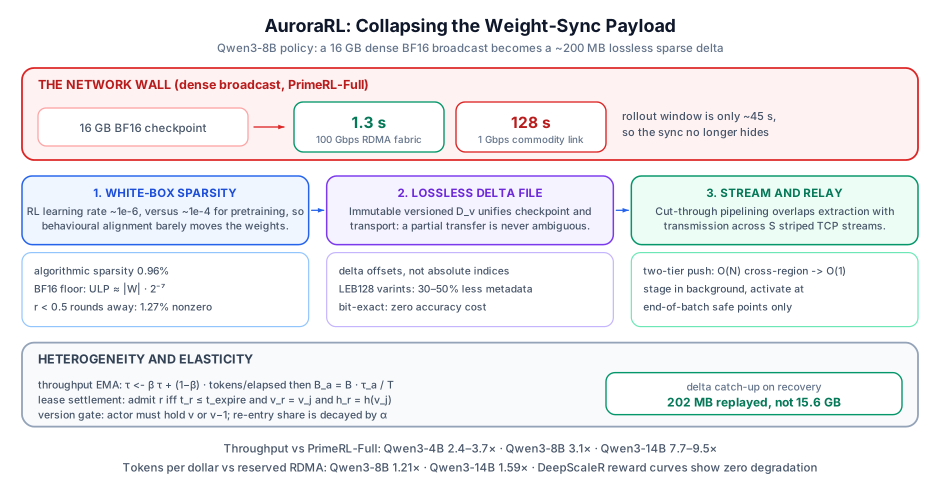
The cleanest way to see how bad C1 is: take a Qwen3-8B policy (16 GB BF16 payload) and time the weight sync against the ~45 s rollout generation window it has to hide inside.
| Network type | Bandwidth | Sync time |
|---|---|---|
| HPC fabric (RDMA) | 100 Gbps | 1.3 s |
| Commodity network | 1 Gbps | 128 s |
At 1.3 s you overlap the sync inside the rollout and never notice it. At 128 s the sync is nearly 3× longer than the entire generation window: the actors spend the majority of wall-clock waiting for a policy they cannot use yet. Standard broadcast-based RL is simply untenable here. This is the same trainer-vs-generator balance problem I covered in RL Systems Mind the Gap, except the imbalance is now imposed by the WAN rather than by rollout length.
2. Quantization-Induced Sparsity
The white-box observation is that RL fine-tuning does not move most weights. Pre-training modifies weights to absorb new knowledge; RL performs behavioral alignment, and it does so at learning rates around $10^{-6}$ versus $10^{-4}$ for pre-training.
Define the element-wise update ratio $\rho$ across $K$ parameter tensors:
\[\rho = \frac{1}{\sum_{k=1}^{K} |W^{(k)}|} \sum_{k=1}^{K} \left\lVert \Delta W^{(k)} \right\rVert_0\]Empirically this ratio is tiny: Qwen3-8B exhibits an algorithmic sparsity of 0.96%.
The BF16 resolution floor
Sparsity gets magnified a second time by hardware precision. Actors consume checkpoints in BF16, but the optimizer works in FP32. Many small FP32 updates fall below the local resolution of BF16 and are therefore invisible to the actor no matter how faithfully you transmit them.
The resolution step size is the unit in the last place:
\[\text{ULP}_{\text{bf16}}(W_i) \approx |W_i| \cdot 2^{-7}\]and the relative update magnitude is
\[r_i = \frac{\left|\Delta^{32}_{t,i}\right|}{\text{ULP}_{\text{bf16}}\!\left(W^{32}_{t,i}\right)}\]Any update with $r_i < 0.5$ rounds away when cast to BF16 for inference. After BF16 checkpoint differencing, only ~1.27% of parameters carry a nonzero update for typical 8B models.
That number is the whole paper in one statistic. Transmitting the other 98.7% is pure waste, and skipping them is not an approximation, it’s bit-exact. Unlike the lossy compression schemes that decentralized training usually reaches for, there is no accuracy budget being spent here. (For the flip side, where precision choices in the RL loop do change the math, see The 4-bitter Lesson: NVFP4 in the RL Loop and Jet-RL and the Precision Mismatch in Reasoning Models.)
3. Lossless Sparse Delta Checkpoints
AuroraRL unifies checkpoint storage and transport behind one artifact: versioned, immutable delta files $D_v$. Immutability matters in a fault-prone network: a partial transfer can never leave an actor in an ambiguous state, because a delta is either fully applied or not applied at all. Every remote actor always holds a verifiable, consistent policy version.
Variable-length index encoding
Sparse updates carry metadata overhead: you must say which elements changed. Absolute indices are wasteful, so AuroraRL stores delta offsets ($\Delta \text{idx}$). Since nonzero updates are scattered but numerous, most offsets are small, and the distribution is a natural fit for LEB128 (Little Endian Base 128) unsigned byte sequences.
Worked example, encoding the value 198:
- Byte 1 (
C6) =1100 0110. High bit1is the continuation flag; payload is100 0110= 70. - Byte 2 (
01) =0000 0001. High bit0marks the final byte; payload is 1. - Reassembly: $70 + (1 \ll 7) = 198$.
Small offsets cost one byte, large ones degrade gracefully. This cuts metadata size by 30–50% while staying bit-exact.
4. Streaming Transfer and Regional Relays
A monolithic transfer over a WAN is maximally exposed to tail latency and the bandwidth-delay product. AuroraRL attacks both with concurrency:
- Cut-through pipelining. Delta segments start transmitting as they are being extracted, overlapping compute with communication instead of serializing extract-then-send.
- TCP multi-stream striping. The delta is segmented round-robin across $S$ parallel streams. This saturates the link and, crucially, prevents one loss-induced stall from head-of-line blocking the entire payload.
Two-tier push
Across regions, the naive fan-out is $O(N)$ cross-region copies. AuroraRL designates a regional relay that receives exactly one copy of the delta and fans it out to local actors over fast intra-region links, collapsing cross-region traffic to $O(1)$. It’s the WAN analogue of the hierarchical collectives discussed in NCCL GIN & MSCCL++, same topology-awareness argument, three orders of magnitude further out in latency.
The protocol separates staging (background transfer, which may be in flight at any time) from activation. Updates are applied via flat scatter-add only at end-of-batch safe points, so no rollout is ever generated against a half-synchronized model. That guarantee is what keeps the sparse path from silently becoming off-policy in a way the trainer can’t account for.
5. Heterogeneity-Aware Scheduling
Uniform work distribution across mixed GPUs manufactures stragglers. AuroraRL collapses every source of slowdown (weaker silicon, worse link, noisy neighbor) into one EMA feedback signal on observed throughput:
\[\tau_a \leftarrow \beta \tau_a + (1 - \beta) \cdot \frac{\text{tokens}}{\text{elapsed}}\]Batch splitting is then proportional to measured throughput:
\[B_a = \left\lfloor B \cdot \frac{\tau_a}{T} \right\rfloor, \qquad T = \sum_{a \in E} \tau_a\]The elegance is in not modeling the cause. You don’t need a hardware taxonomy or a link-quality probe; the actor that finishes fewer tokens per second gets fewer tokens.
Version-aware gating guards staleness: an actor is eligible only if it holds version $v$ or $v-1$. An actor that fell behind and is rejoining gets its throughput share multiplied by a decay factor $\alpha$, so it re-enters conservatively and earns its full share back only after demonstrating sustained performance. Without the decay, a recovered actor’s stale EMA would immediately win it a large batch it cannot finish.
6. Non-Blocking Consensus and Elastic Fault Tolerance
Rigid synchronous barriers are the wrong primitive when membership churns. AuroraRL uses a stochastic, lease-based model that allows actors to join or leave without pausing the survivors. At settlement the trainer applies an acceptance predicate:
Admit result $r$ for job $j$ iff $t_r \le t_{\text{expire},j}$, $v_r = v_j$, and $h_r = h(v_j)$.
Deadline, version, and hash: a straggler’s late result is dropped rather than allowed to stall the step, and a result computed against the wrong policy version can never be silently mixed in.
Delta catch-up: the killer stat
When an actor recovers, it doesn’t reload the model. It replays a chain of sparse deltas. For Qwen3-8B that means streaming ~202 MB instead of a 15.6 GB full model reload. A multi-minute recovery becomes a multi-second one.
This is what makes spot capacity genuinely usable. Preemption stops being a catastrophe amortized over the campaign and becomes a routine event with a bounded, small cost. Compare with the asynchronous-rollout machinery in GLM-5.3’s Single-Rollout Asynchronous RL and the replay design in Experience Replay for LLM RL: both tolerate staleness, but AuroraRL makes rejoining cheap rather than making staleness acceptable.
7. Benchmarks and Economics
Against PrimeRL-Full, a dense-broadcast baseline, throughput gains widen with model size, as they should, since the dense payload grows linearly while the sparse delta grows with the (roughly constant) update ratio:
| Model | Throughput improvement vs. PrimeRL-Full |
|---|---|
| Qwen3-4B | 2.4× – 3.7× |
| Qwen3-8B | 3.1× |
| Qwen3-14B | 7.7× – 9.5× |
Accuracy verification on DeepScaleR reward curves shows zero degradation versus dense baselines. This follows directly from bit-exactness: the sparse update is not an approximation of the dense update, it is the dense update with the provably-zero entries omitted.
Tokens per dollar
The economic claim is the one that matters strategically:
| Model | Tokens per dollar vs. reserved RDMA |
|---|---|
| Qwen3-8B | 1.21× |
| Qwen3-14B | 1.59× |
On-demand commodity GPUs beat reserved RDMA clusters on cost-efficiency once the network wall is gone. That inverts the standing assumption that the HPC premium is unavoidable for frontier RL.
Takeaways
- RL updates are sparse twice over: once algorithmically (0.96% for Qwen3-8B, from $10^{-6}$ learning rates), and again through the BF16 resolution floor. Net: ~1.27% of parameters carry a nonzero BF16 delta.
- The savings are lossless. Bit-exactness means the accuracy conversation is over before it starts, a rare property in decentralized training, where compression usually costs reward.
- Immutable versioned deltas are the right storage abstraction, not just the right transport one. They unify checkpointing and sync, and make partial transfers unambiguous.
- Recovery cost, not steady-state throughput, is what gates spot capacity. 202 MB versus 15.6 GB is the difference between spot being a liability and spot being a strategy.
- Measure, don’t model, heterogeneity. One throughput EMA plus a version gate handles A100/H100 mixes, bad links, and rejoining stragglers without a hardware taxonomy.
The broader read: the “HPC premium” has been an implicit tax on who gets to do frontier RL. Papers like this one make the tax optional. For the tightly-coupled counterpart (squeezing the last percent out of a single well-connected cluster), see RoutePack and Infra Math for LLM Training.