Le Critique: Privileged Value Functions and the Return of Credit Assignment in LLM RL
Reading notes on:
Modern LLM RL mostly walked away from critics. The reason was pragmatic: actor-critic systems are harder to scale, harder to keep numerically aligned, and much easier to destabilize than group-relative baselines. That trade made sense in the throughput-driven era mapped out by StreamRL and RL Systems Mind the Gap.
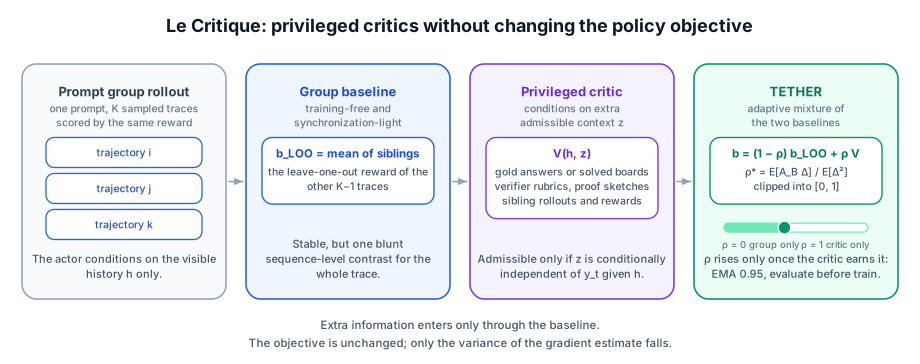
But the cost of dropping the critic is real. Group baselines give one blunt sequence-level signal to an entire response, which is exactly the wrong shape for long reasoning traces. Le Critique asks whether token-level credit assignment can come back without resurrecting the instability that made the field abandon PPO-style critics in the first place. Its answer is elegant: let the critic see privileged but admissible information, then mix that value estimate with the reliable group baseline using a learned coefficient.
1. What the PPO to GRPO Shift Bought, and What It Lost
The generic token-normalized policy-gradient estimator is
\[\hat{\nabla}_\theta J = \frac{1}{\sum_{i=1}^B T_i} \sum_{i=1}^B \sum_{t=1}^{T_i} w_{i,t}\,\hat{A}_{i,t}\,\nabla_\theta \log \pi_\theta(y_{i,t} \mid h_{i,t}).\]Everything interesting is packed into the advantage estimator $\hat{A}_{i,t}$.
In actor-critic methods, that advantage can vary token by token. In group-relative methods, it is effectively sequence-level. The leave-one-out baseline
\[b_i^{LOO} = \frac{1}{K - 1}\sum_{j \ne i} R_j\]and the GRPO baseline
\[A_i^{GRPO} = R_i - \bar{R}\]are equivalent up to a constant scale:
\[A_i^{GRPO} = \frac{K - 1}{K} A_i^{LOO}.\]That is why critic-free RL scales cleanly: the baseline is training-free and synchronization-light. But it is also why it struggles to tell which reasoning step mattered. The whole trajectory shares a single reward contrast.
This explains the historical split:
| Method | Credit assignment | Infra burden | Failure mode |
|---|---|---|---|
| PPO / actor-critic | token-level | high | critic lag, instability |
| GRPO / RLOO | sequence-level | low | blunt temporal credit |
The paper’s aim is not to revert to old PPO. It is to recover critic granularity without paying the full systems tax.
2. The Key Theoretical Boundary: Admissible Privilege
The crucial idea is that a critic can condition on more information than the policy, as long as that extra information does not leak the sampled action itself.
The sufficient admissibility condition is
\[\mathbb{E}\!\left[b(h_{i,t}, z_{i,t}) \nabla_\theta \log \pi_\theta(y_{i,t} \mid h_{i,t}) \mid h_{i,t}\right] = 0 \quad \Longleftarrow \quad z_{i,t} \perp\!\!\!\perp y_{i,t} \mid h_{i,t}.\]So the question becomes: what counts as admissible privilege?
Safe examples:
- gold answers or solved boards;
- verifier rubrics or proof sketches;
- sibling rollouts and rewards from the same prompt group, excluding the current trajectory.
Unsafe examples:
- future tokens of the trajectory being scored;
- the realized terminal reward of that exact trajectory;
- environment feedback that only exists because the current action was taken.
This distinction is load-bearing. It turns privileged critics from a hand-wavy systems trick into a proper control-variate construction.
3. Privileged Value Functions
The proposed critic is a Privileged Value Function (PVF):
\[V^\pi(h_{i,t}, z_{i,t}) = \mathbb{E}_{\tau_i \sim \pi}[R_i \mid h_{i,t}, z_{i,t}].\]The paper’s motivating example is Sudoku. A standard critic observing only a partial board has to implicitly solve a difficult latent inference problem to predict the return. A privileged critic that also sees the completed board turns that into verification rather than search.
The gain is formal:
\[\mathbb{E}\Big[(R_i - \mathbb{E}[R_i \mid h_{i,t}, z_{i,t}])^2\Big] \le \mathbb{E}\Big[(R_i - \mathbb{E}[R_i \mid h_{i,t}])^2\Big].\]So, with an optimal predictor, adding admissible privilege can only reduce variance.
That makes PVFs quite different from self-distillation or reward shaping. They are not changing the RL objective. They are estimating a better baseline.
4. TETHER: Let the Baseline Decide When to Trust the Critic
Even a principled critic can be wrong early in training. The paper’s fix is TETHER, an adaptive mixture between the stable group baseline and the learned value baseline:
\[b_{i,t}^{TETHER} = (1 - \rho)\, b_i^{LOO} + \rho\, V_{i,t}.\]Define the group advantage and value correction as
\[A_B = R - B, \qquad \Delta = V - B.\]Minimizing the least-squares prediction error gives the optimal mixture coefficient
\[\rho^* = \text{clip}_{[0,1]} \left( \frac{\mathbb{E}[A_B \Delta]}{\mathbb{E}[\Delta^2]} \right).\]This is a good design for two reasons:
- When the critic is useless, $\rho$ collapses toward zero and the algorithm falls back to the safe group baseline.
- When the critic becomes predictive, $\rho$ increases smoothly and token-level credit gradually takes over.
In implementation, $\rho$ is smoothed with an EMA using decay 0.95, and the paper insists on an evaluate-before-train protocol so that the critic is scored on data it has not just memorized.
5. What the Results Actually Say
The most direct metric is critic explained variance:
| Task | Standard VF EV | PVF EV |
|---|---|---|
| Sudoku ($K=4$) | 0.032 | 0.245 |
| CodeIO ($K=4$) | 0.594 | 0.751 |
| Reasoning Gym ($K=8$) | 0.499 | 0.519 |
That is a big jump, especially on Sudoku where the latent search problem is hardest.
But the headline is more nuanced than “critic wins everywhere.”
- On Sudoku, TETHER mitigates the damage from a weak standard critic, but the plain group baseline still slightly outperforms it in final reward.
- On MiniF2F and Reasoning Gym, TETHER wins, which suggests token-level credit matters most when partial prefixes already contain useful proof structure or semantic evidence.
The paper also highlights a long-context tuning detail that is easy to miss and likely more general: for long CoT, $\lambda_{GAE}$ may need to sit extremely close to 1. The reported sweet spot is
\[\lambda_{GAE} = 0.999888,\]chosen so the first token in an 8,192-token trajectory still retains roughly 40% of the terminal reward signal. A default value like 0.95 simply washes the credit out.
6. Why This Matters
The paper restores an old idea in a more modern form:
- Critics do not need to be policy clones. They can be privileged verifiers as long as the privilege is admissible.
- Group baselines remain the right bootstrap. TETHER is persuasive precisely because it does not force the critic to be trusted before it earns that trust.
- The real value of critics is temporal resolution. They help most when long reasoning traces contain locally diagnostic partial structure.
- This is a control-variate story, not a reward-model story. The objective remains the same; only the variance changes.
My read is that this is the right way to bring critics back into large-scale LLM RL. It does not pretend the GRPO era was wrong. It accepts the systems constraints that killed old actor-critic pipelines, then reintroduces value functions only where they can be mathematically defended and operationally hedged.